
Sensory-Friendly Holiday Decorating Guide

Holiday decor can tip a regulated kid into overload: blinky lights, new smells, cluttered rooms, fragile ornaments. You can still decorate. Change how much, how fast, and what materials you use.
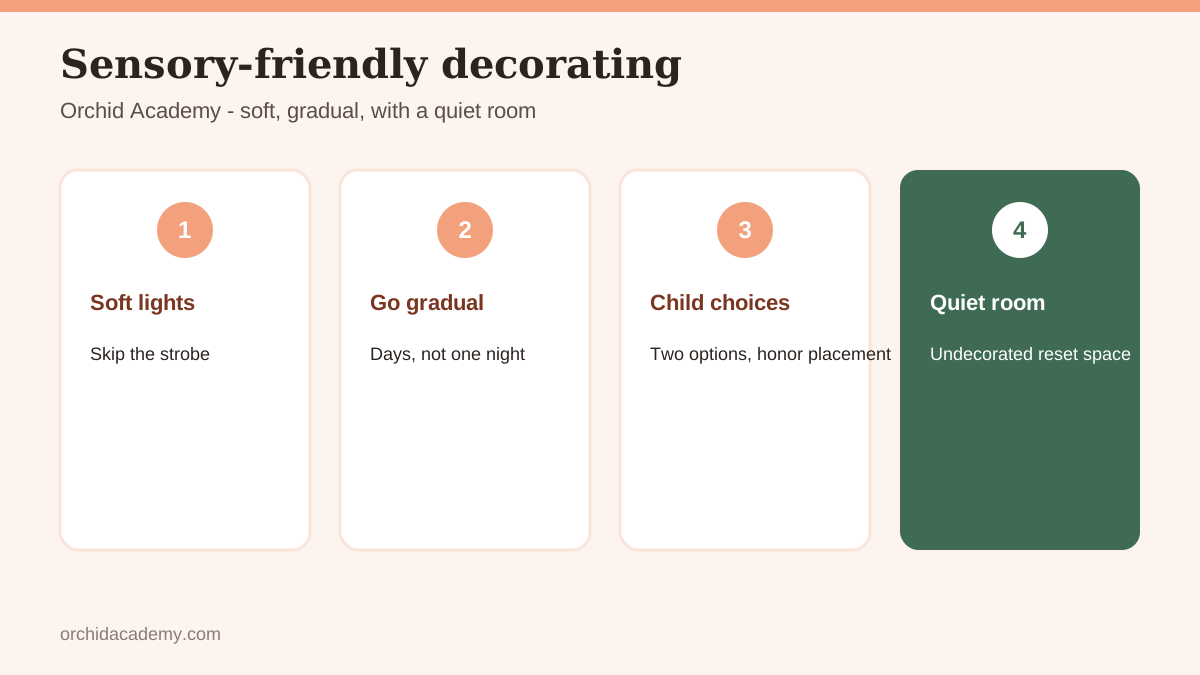
Practical rules
- Softer inputs. Warm static lights over strobing ones. Calmer colors and soft textures when you can.
- Go gradual. One shelf or one tree section at a time over days, not a full house overnight.
- Use a visual schedule. Include putting decorations up and taking them down so the end is not a surprise.
- Give real choices. Two ornament options, one place to hang them. Honor the location they pick.
- Keep a quiet room undecorated (or lightly so) as a reset space.
- Skip breakables if your child throws when upset or has a hard time with fragile items. Soft and light wins.
- Practice the tradition. Unwrapping, candle lighting, or hanging stockings can be session goals. Ask your BCBA.
Pair with holiday priority planning so you are not decorating for events you already decided to skip. Email hope@orchidacademy.com or contact us if you want support building a decorating or unwrapping plan.
Lights, sound, and smell
Blink, flash, and color-cycle lights are the usual trigger. Warm-white LEDs on a static setting are easier on most nervous systems than cool-white strobes. Put lights on a timer so they do not turn on in the child’s face at 5 a.m., and keep a physical off switch you can reach without crawling under the tree.
Skip scented pine sprays, potpourri simmer pots, and candles in the main living space if smell is a known issue. One undecorated, unscented room is more useful than a “subtle” cinnamon stick in every doorway.
Music is optional. If you play it, keep it in one room and keep a way to turn it off that the child can request (word, device, card). A house that sings from every speaker is a house with no off switch.
The tree, if you still want one
A smaller tree in a corner beats a floor-to-ceiling tree in the walk path. Hang unbreakable ornaments on the bottom third. Put anything glass or sentimental above reach, or leave it in a box this year.
Let the child hang two ornaments they chose and call it decorated. A full designer tree that nobody can touch teaches the wrong lesson and breaks on Thursday.
If the tree itself is too much, decorate a shelf, a single wreath on one door, or a tabletop tree in a room the child can leave.
Go up slowly, come down on a schedule
Put decorations up over several days. Take them down on a named day on the visual schedule, such as “Lights come down on January 2 after breakfast.”
If taking decorations down is as hard as putting them up, practice both in session. Removing items is a change in the environment, same as adding them.
Materials that survive a hard day
Felt, wood, fabric, and plastic beat glass and ceramic. Command hooks beat nails if walls get climbed. Keep cords taped and out of mouths. If your child mouths objects, skip small ornaments and tinsel entirely.
Edible decorations (gingerbread, popcorn strings) are a problem if your child will eat the display or if food rules are already a fight. See picky eating before you turn the tree into a snack.
Frequently asked questions
What if my child wants none of it? Skip decorating, keep the quiet room, and put energy into the two traditions on your holiday priority list. Relatives can decorate their own houses.
Are sensory-friendly lights a real product or a marketing line? Look at whether the light is static or flashing, and whether you can dim it. A $12 warm-white string on “steady” beats a “sensory” product that still strobes.
Should we decorate the child’s bedroom? Usually no. Bedrooms work better as the reset space. Decorate shared rooms if you decorate at all.
Can this be an ABA goal? Yes: hanging an ornament, requesting “lights off,” waiting while you hang something, or helping pack the bin. Ask your BCBA to write it as a short holiday unit.
See how our team can support your child
Dr. Autumn Flick, BCBA
Board Certified Behavior Analyst
Keep exploring
- Parent & family training
Coaching that fits your family's routines and goals.
- ABA therapy at Orchid Academy
How we build communication, independence, and daily living skills.
- Request a call back
Ask about programs that match your child's needs.
Related Articles
Social Skills for Teens With Autism: Friendships, Boundaries, and Real-Life Practice
Practical, age-respectful social skills for autistic teens: friendships, group chats, boundaries, self-advocacy, and ways to practice without forced masking.
Sep 22, 2026 · 3 min read

How Storytelling Supports Literacy and Learning for Children
How shared storytelling builds vocabulary, sequencing, and social understanding for autistic kids, and how to use personalized stories alongside ABA goals at home.
Aug 22, 2026 · 4 min read

Picky Eaters with Autism: Embracing Mealtime with Compassion
Why picky eating is common in autism, and concrete steps for introducing new foods without turning dinner into a fight.
Feb 2, 2025 · 2 min read