
How Many Hours of ABA Therapy Does My Child Need?
Updated September 1, 2026 · For decisions about your child, speak with your BCBA.
Quick answer: there is no standard number of ABA therapy hours for every child. A BCBA recommends a weekly range after considering your child's goals, age, learning needs, and family routine.
Comprehensive early-intervention plans often run 30-40 hours a week, while focused plans working on a narrower set of goals can be as low as 4-6 hours a week. Those ranges are a starting point, and your BCBA should revisit the plan as your child grows. This guide explains how families make the hours work alongside naps, school, and real life.
Comprehensive vs. Focused: The Two Kinds of ABA Plans
Parents often hear one number and assume every child should land there. In practice, recommendations usually fall into two buckets:
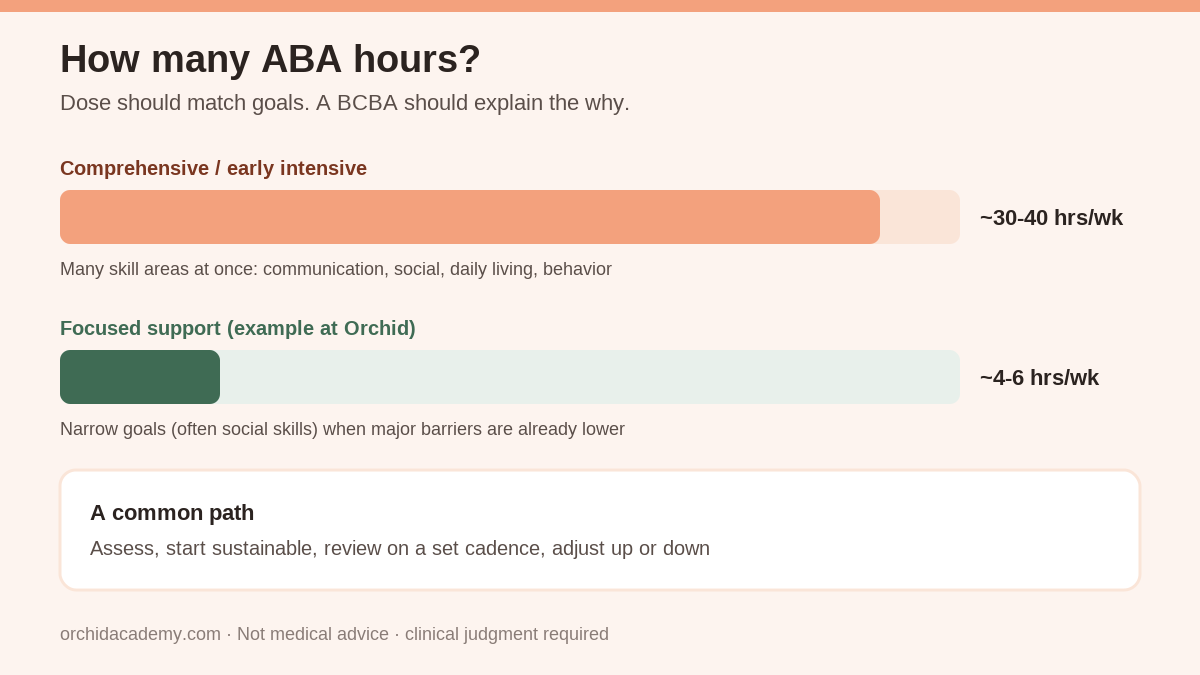
- Comprehensive (early intensive) plans often land around 30 to 40 hours a week when many skill areas need teaching at once (communication, social skills, daily living, and behavior).
- Focused plans can be much lower. At Orchid, children who mainly need social-skill support and do not have major behavior barriers may do well with about 4 to 6 hours a week of targeted ABA.
You may also hear 10, 20, or 25 hours described as "focused" ranges. The label matters less than whether the hours match the goals. A BCBA should be able to explain why they recommended a range for your child.
How Often Is ABA Therapy Each Week?
Most learners attend sessions several days a week. The weekly rhythm follows from the total hours in the plan: a 6-hour focused program might be two or three sessions, while a comprehensive program looks more like a school week. Your BCBA builds the schedule around your family's routine: work hours, school, siblings.
How Long Is an ABA Therapy Session?
Session length is tailored to your child's age, attention span, and goals: a toddler's schedule accounts for naps and play, while a school-age learner's sessions may run longer. Session length is set in the same assessment that recommends weekly hours, and it can change as your child's stamina for learning grows. For what happens inside a session (warm-up, goal work, reinforcement, data collection, and parent check-ins), see how ABA therapy works at Orchid. For a practical session-by-session planning checklist, read how long ABA therapy sessions run.
ABA Therapy Hours by Age
- Under about three: attention spans and naps limit how dense a day can be. Many families start lower and build as the child tolerates more teaching. Comprehensive recommendations are still common at this age because early intervention is when intensive teaching has the strongest research support.
- School-aged: therapy has to share the calendar with school and downtime. An IEP is the school's offer; clinic hours are a medical plan. They can share a week. Providers who refuse to talk about that fit are not listening. For many families, school-based ABA or after-school hours make the schedule workable. See the Washington IEP guide for the school side.
Hours are not a loyalty test. They are a dose estimate.
Federal Guidance Puts Intensity at About 5 to 40 Hours
On August 4, 2026, CMS released a State Medicaid and CHIP ABA toolkit for state agencies. It notes that appropriate ABA intensity varies from roughly 5 to 40 hours a week depending on the individual child, and it cautions against treating high hours as a default. That is the same spread as comprehensive vs. focused plans. It is guidance to states, not a cut to your current authorization, and Washington has not announced a new hour cap in response.
If a clinic quotes 30 to 40 hours on the intake call, before anyone has watched your child, that number is a business model. Hours should be able to go down as skills stick, not only up. Our post on ABA billing red flags is the longer parent checklist.
If a Reassessment Added Behaviors You Do Not See
Parents sometimes get a new assessment that lists extra target behaviors, then hear that without those items the hours, or the authorization, would drop. Ask what changed in your child's day. A goal list should match what you and the BCBA actually observe. Padding a behavior list to protect billing is a reason to push back, not a favor.
What the Research Says About ABA Hours
In 1987, Dr. Ivar Lovaas and colleagues at UCLA studied intensive ABA (about 30 to 40 hours a week, one-on-one) for young children with autism. Among children in the intensive group, 47% achieved typical intellectual and educational functioning on the study's measures. Later studies repeated parts of that early intensive model with similar patterns. Intensive models still vary, and no hour count guarantees those outcomes for any individual child. Read the original 1987 study record.
Lovaas and later researchers also warned that too few hours during early development can slow foundational skills: school readiness, independence, and basic life skills. That is the case for intensive recommendations. It does not mean every school-aged child with mild support needs must sit at 40 hours. For the full research walkthrough with citations, read our deeper guide, How Many Hours of ABA Therapy Does My Child Need? (the research deep dive).
Is 6 Hours of ABA a Week Enough?
Sometimes, yes. If goals are narrow and the child already has strong learning-to-learn skills, focused hours can move the needle. If the child is young, needs help across many domains, or is losing skills without teaching, 6 hours is usually not enough intensity. That is a clinical judgment, so ask your BCBA to defend the number against your child's assessment.
Starting Lower and Ramping Up
Lots of parents start skeptical of high hours and choose a lighter schedule first. When communication improves, social attempts increase, or hard behaviors drop, many ask to add time. Seeing change changes what feels "too much." A workable process looks like this:
- Assess goals and current skills.
- Pick a starting dose the child and family can sustain.
- Review progress on a set cadence with the BCBA.
- Adjust up or down without drama.
Ask out loud: Can we start lower and increase? How will we know it's time? How do you protect naps, homework, and parent work schedules? Flexible clinics answer those questions without shaming.
What If You Get Fewer Hours Than Recommended?
Sometimes the limiter is family capacity; sometimes it is an insurance authorization that approves fewer hours than the treatment plan recommends. Either way, start with your BCBA: they can prioritize the goals that matter most within the hours you have and set a review date. If insurance is the constraint, authorizations can be appealed. Our guide to ABA therapy insurance coverage in Washington covers the approval roadmap, and what to do if a claim is denied walks through reconsideration step by step. If hours dropped at a renewal, see why insurance cuts hours at ABA reauthorization. At Orchid, the care team handles authorizations and reauthorizations so hours don't lapse mid-plan.
FAQs
How many hours of ABA therapy is recommended for a 3-year-old?
Young children working on many skill areas at once often receive comprehensive recommendations in the 30-40 hours-per-week range, because that is the intensity early-intervention research has studied most. At the same time, naps and short attention spans limit how dense a toddler's day can be, so many families start lower and add hours as their child tolerates more teaching. The specific number should come from your BCBA's assessment, not a template.
How many days a week is ABA therapy?
Most learners attend sessions several days a week. Your BCBA builds the weekly schedule around your family's routine, so the number of days follows from the total hours in your child's plan rather than a fixed template.
Can ABA hours change over time?
Yes. Hours are a dose estimate. A good plan sets a review cadence with your BCBA so hours can move up when goals expand or down as skills generalize, without drama either way.
What happens if my child gets fewer ABA hours than recommended?
Talk to your BCBA first. They can prioritize the most important goals within the hours you have and set a review date to reassess. If an insurance authorization is what's limiting hours, families can appeal. At Orchid, the care team handles authorizations and helps families through appeals and reauthorizations.
How long does ABA therapy last overall?
There is no fixed endpoint. Plans are reviewed with your BCBA on a set cadence, insurance reauthorizations typically happen every six months, and hours adjust as your child meets goals. The right length is the one your child's progress data supports.
Can my child do ABA and school in the same week?
Yes. An IEP is the school's offer of a school day; clinic ABA is a medical plan. Many families run school in the morning and ABA in the afternoon, or keep a lighter clinic dose on school days. What limits it is your child's stamina.
What if a new ABA assessment added behaviors I don't see at home?
Ask what changed in your child's day, not what changed on the form. Hours should follow what you and the BCBA actually observe. If the extra items exist mainly so authorized hours do not drop, push back.
Related guides & next steps
Hours are one decision inside a bigger plan. These pages cover the rest.
- ABA therapy at Orchid
What sessions look like and the programs behind the hours.
- Early intervention
Why intensive hours matter most for the youngest learners.
- Understanding autism
Early signs, diagnosis paths, and what autism is not.
- New autism diagnosis guide
First steps after a diagnosis for Washington families.
- Washington IEP guide
Washington eval clocks, advocacy, and school plus clinic in one week.
- How long ABA therapy lasts
Months, years, six-month reviews, and discharge.
- The hours research deep dive
Lovaas, later replications, and the full citation list.
Not sure what the right number is for your child?
An assessment answers it better than any article can. Our team can also check your insurance benefits before you commit to anything.
Talk Through ABA Therapy Hours With Orchid Academy
Tell us about your child and we'll walk through what a reasonable schedule could look like.
Free, no-obligation conversation
Free, no-obligation conversation
Request received
A member of the Orchid Academy care team will call you back within 24 hours to talk through next steps. Prefer to talk now?
Call (425) 699-7164