
Social Skills for Autistic Girls at School: Elementary to High School

Social support should make school and friendships more workable—not train a child to hide who she is. Some autistic girls want a large social circle; others prefer one close friend, an interest-based club, or more quiet time. A good goal starts with what she wants to be easier: joining an activity, recognizing an unkind dynamic, texting less anxiously, or recovering after a crowded school day.
Communication differences are part of autism, but they do not look the same in every child or setting. The National Institute on Deafness and Other Communication Disorders offers a family-facing overview of communication differences in autistic children. This guide turns that broad topic into practical school questions for families.
Start with a goal the student recognizes
Avoid goals such as “make more friends” or “look typical in conversation.” They are vague and can reward exhaustion instead of connection. Try a specific, observable goal instead:
- Ask one classmate about a shared interest at lunch.
- Tell a trusted adult when a joke feels confusing or mean.
- Leave a group chat for the evening without apologizing repeatedly.
- Ask for a quiet reset after a noisy school event.
- Practice one way to say no when a peer suggests something unsafe or uncomfortable.
The skill may be speaking, noticing, planning, or recovering. The point is agency—not perfect performance.
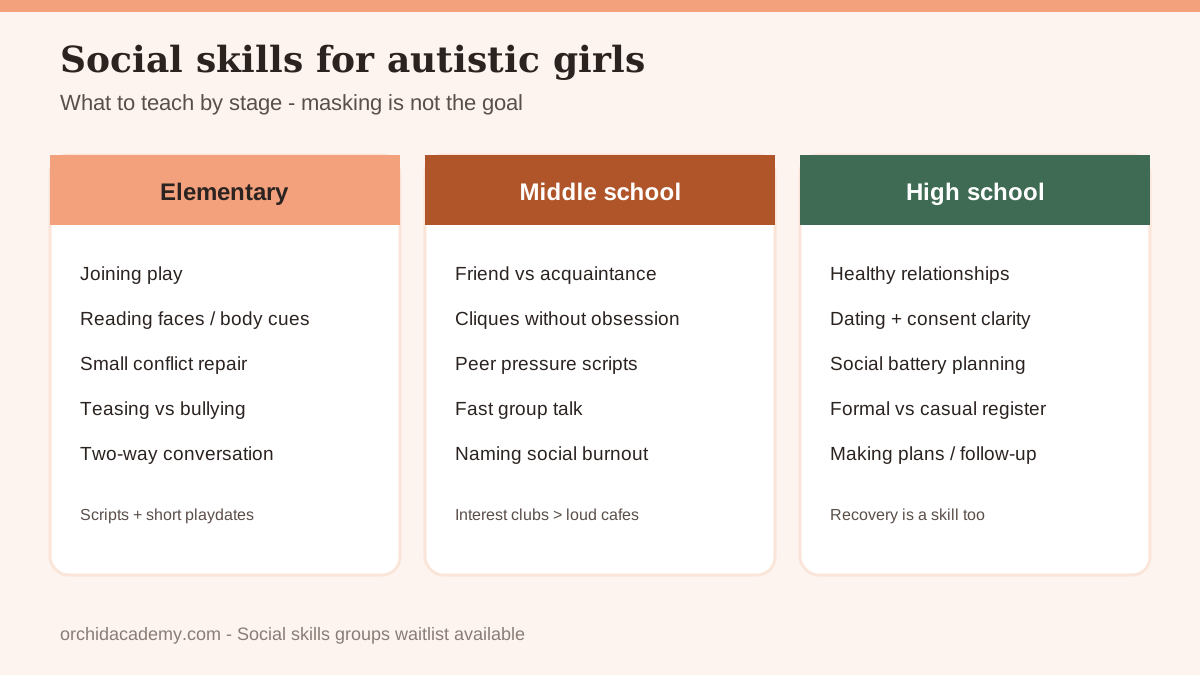
Elementary school: joining, repairing, and asking for help
At this stage, social practice is often easiest inside a shared activity: drawing, a game, a lunch club, or a short playdate with a clear beginning and end.
- Joining in: Practice two simple openings: “Can I play?” and “What job can I do?”
- Taking turns: Use a visual or timer when a game moves too quickly to track.
- Repairing a mix-up: Give a short script such as, “I didn’t understand. Can we try again?”
- Separating teasing from bullying: Teach that a joke is not okay when someone asks it to stop, feels unsafe, or is repeated to hurt someone.
- Getting adult help: Identify one adult and one sentence the child can use: “I need help with something that happened at recess.”
Ask the teacher where interaction is already happening naturally. Recess, art, a classroom job, or an interest club can be a more comfortable practice setting than a forced social exercise.
Middle school: hidden rules, group chats, and energy limits
Middle-school peer groups can change quickly. It helps to name the rules that are often left unspoken without suggesting that the student has to chase every trend.
- Friend categories: A classmate, acquaintance, activity friend, close friend, and unsafe peer do not require the same access to personal information or time.
- Group conversations: Practice noticing a topic change and using one bridge question: “How did that go?” or “What happened next?”
- Digital boundaries: Decide together when messages can wait, what information stays private, and when a screenshot or blocked contact should go to an adult.
- Recovering after school: A quiet routine, snack, movement, special interest, or no-talk window can be a planned support—not a consequence for being social.
- Self-advocacy: Rehearse, “I need a minute,” “I don’t want to do that,” and “Can you explain what you mean?”
If a student appears fine at school but is distressed or depleted at home, bring that pattern to the school team. It is useful information about the cost of the day, not proof that she is doing well or poorly.
High school: boundaries, consent, and adult-life practice
High school adds dating, jobs, driving or transit, team projects, and more independent online communication. The safest teaching is direct and concrete.
- Talk about consent, privacy, pressure, and what a respectful relationship looks like before a crisis.
- Practice how to decline a plan, leave a situation, and contact a trusted adult without needing a perfect explanation.
- Discuss online safety: requests for photos, location sharing, money, passwords, and private conversations with adults.
- Practice workplace and teacher communication separately from friendship language.
- Keep recovery time on the calendar during exams, performances, athletics, or social events.
No article can replace a safety plan when a child is being pressured, bullied, or harmed. In those moments, involve a trusted adult, school staff, and appropriate professional or emergency support right away.
A school meeting agenda that is actually useful
Bring one recent example, one strength, and one request. For example: “She loves science club, but lunch is unpredictable and she comes home overwhelmed. Can we identify a quieter option twice a week and a staff member she can check in with?”
Then ask:
- Where does she already feel connected or competent at school?
- Which situations are draining, confusing, or unsafe?
- What small support can we try for four to six weeks, and how will we ask her whether it helped?
School supports may live in different places depending on the student’s needs. Our Washington IEP guide explains the special-education process, while an interest-based club, counseling support, or a trusted staff check-in may not require an IEP change.
What the research can and cannot tell you
Research on autistic girls is growing, but no study can predict an individual child’s friendships or needs. One study of school-age girls found social-communication differences compared with non-autistic girls, even where a child might appear more socially fluent at first glance. Read the study abstract.
Use research as a prompt to listen more closely, not as a checklist for stereotyping. The student is the best source for which interactions feel good, difficult, confusing, or worth practicing.
For group options, see Orchid’s social skills groups. To talk through support that fits your child’s actual school day, request a call back.
Find out how our expert team can support your child’s journey:
Dr. Autumn Flick, BCBA
Board Certified Behavior Analyst
Keep exploring
- Social skills groups
Group sessions that build connection through guided practice.
- Parent & family training
Coaching that fits your family's routines and goals.
- ABA therapy at Orchid Academy
How we build communication, independence, and daily living skills.
Related Articles

How Storytelling Supports Literacy and Learning for Children
How shared storytelling builds vocabulary, sequencing, and social understanding for autistic kids—and how to use personalized stories alongside ABA goals at home.
Aug 22, 2026 · 4 min read

Picky Eaters with Autism: Embracing Mealtime with Compassion
Why picky eating is common in autism, and concrete steps for introducing new foods without turning dinner into a fight.
Feb 2, 2025 · 2 min read
An Example Toilet Training Plan for Children with Autism
A phase-by-phase toilet training plan for autistic children: scheduled trips, communication prompts, accident response, and how to fade support.
Feb 23, 2025 · 2 min read