
ABA Reauthorization: What Insurance Reviews and Why Hours Get Cut
ABA reauthorization is the insurance review that decides whether your child’s therapy keeps going after the current approval ends, and at how many hours. Most parents learn the word the day a BCBA tells them the plan approved fewer hours than they asked for.
The review isn’t random. Each plan publishes what it looks for, and you can affect most of it in the month before the request goes in. Below is what Washington Apple Health and three large commercial carriers say, in plain terms.
How the ABA reauthorization cycle works
Every ABA approval has an end date. Before that date, your provider sends the plan an updated assessment, progress data, and a treatment plan with the hours it recommends for the next period. The plan approves the request, approves fewer hours, or denies it.
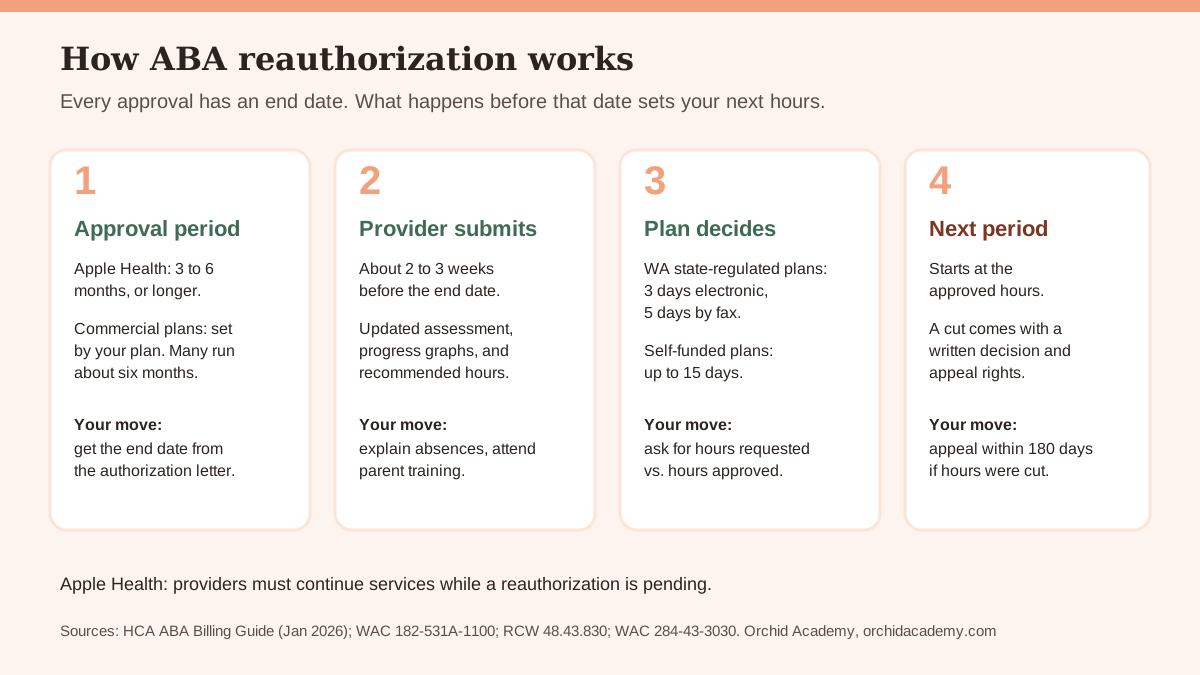
How long an approval lasts. Washington Apple Health “grants authorization in three to six-month increments, or longer at HCA’s discretion,” according to its ABA program billing guide (January 1, 2026 edition, p. 39). The ABA rule itself, WAC 182-531A-1100, says three months or longer. Apple Health managed care plans can set their own periods.
Commercial plans are less specific. Premera’s ABA policy, Regence’s Behavioral Health Policy No. 18, and Cigna’s EN0499 don’t name a fixed approval length. Regence wants goals measured at least every six months, and Premera tells Washington providers that treatment plans should be updated every six months. In practice, a lot of families land on a six-month cycle, but your authorization letter is the only reliable source for your dates.
When the provider has to submit. For Apple Health, the rule says at least 15 calendar days before the approval expires, and the billing guide asks for three weeks in its recertification section. Regence wants the request within five business days before the end of the current authorization and no more than 30 days before. If your plan isn’t one of these, ask your provider what deadline they work to.
How fast the plan has to decide. Washington’s prior authorization law, RCW 48.43.830, gives state-regulated plans 3 calendar days for a complete standard request sent electronically and 5 calendar days for one sent by fax. The clock starts when the plan has what it needs, so a request missing a document waits. Self-funded employer plans follow the federal 15-day rule instead. Our post on how long it takes to start ABA has the full table.
What your provider sends with the request
Apple Health’s billing guide (p. 40) lists the contents of a recertification request:
- An updated Level of Support Requirement form (HCA 12-411), which identifies severe behaviors and classifies any aggression as physical, verbal, or property
- A reevaluation and revised treatment plan showing measurable changes in how often, how intensely, and how long the target behaviors happen
- A projection of the eventual outcome, the assessment tools used, and developmental markers of readiness for less intensive care
- Evidence that the provider is coordinating with your child’s other providers
HCA can also ask the Center of Excellence that wrote the original ABA order to review the case. That can mean a record review, a caregiver conference, a visit, or a second opinion.
Cigna asks for the same kind of file in different words. Current data on every goal has to be from within 60 days of the request, a standardized assessment has to be less than a year old, and caregiver goals have to show that parents are still taking part and making progress. Our Cigna ABA guide walks through the whole policy.
Why insurance cuts ABA hours at reauthorization
Apple Health is the clearest about this, because it lists the reasons it can deny or reduce continued hours (billing guide p. 41, and the same list in WAC 182-531A-1100):
- No response to treatment after different techniques have been tried
- No harmful behaviors, such as physical aggression or property destruction, when those were part of the reason for the hours
- No meaningful progress, or a plateau, without documentation of significant interfering events. HCA’s examples are serious physical illness, major family disruption, and a change of residence.
- A demonstrated lack of engagement by the child or family, such as missed appointments, missed family training, or skipped homework. HCA adds that “absences that are reasonably justified, such as illness, are not considered a pattern.”
HCA also defines meaningful progress. The change has to show up in the data, appear in charts and graphs, hold over time, and be seen outside the therapy room.
Commercial plans use similar ideas. Regence asks for functional and measurable progress and for evidence that your child can’t be served at a less intensive level of care. Cigna asks for ongoing and sustained progress, and any request for more hours needs its own clinical reason and data.
Notice what that means. A child who makes no progress can lose hours, and so can a child who makes a lot of progress, because the plan reads that as a sign the intensity can come down.
Clinical taper or insurance cut? How to tell
A drop in hours can come from three places, and each one calls for a different response.
- Your BCBA asked for fewer hours. That’s a clinical decision. A good treatment plan includes fading, and a planned step down as goals are met is what therapy is supposed to do. You’re still owed an explanation. Ask which goals were met, what the data shows, and what the plan is if skills slip.
- Your BCBA asked for the same hours and the plan approved fewer. That’s a payer decision. The plan has to put it in writing, with the reason and your appeal rights. This is the one you can appeal.
- The hours are approved but your child isn’t getting them. That’s a staffing problem at the provider, and it can feed the next review, because a plan that sees 20 delivered hours out of 30 approved may question the 30. Our post on ABA therapist turnover covers what to ask.
The fastest way to sort it out is one question to your provider: “How many hours did you request, and how many did the plan approve?” If the two numbers match, the change came from the clinical team. If they don’t, ask for a copy of the plan’s decision.
What to do in the month before the review
You can’t write the treatment plan, but you control several things the reviewer will read.
- Get the dates. Ask for the current authorization’s end date and the date the request will go in. Put both on your calendar.
- Explain absences as they happen. If your child misses for illness, a family emergency, or a move, tell the provider why, in writing if you can. Apple Health says justified absences aren’t a pattern, but the reviewer only knows they were justified if the record says so.
- Show up for parent training. Cigna requires caregiver goals with data, and Apple Health counts missed family training as lack of engagement. If the time slot doesn’t work, ask for another one, a shorter session, or video. Here’s what a parent training session (CPT 97156) should look like.
- Report anything that set your child back. A hospital stay, a new sibling, a divorce, a move, or a change in medication can explain a flat stretch in the data. HCA names these kinds of events as reasons a plateau doesn’t count against continued care.
- Bring examples from outside therapy. HCA wants progress seen outside the treatment setting. A teacher’s note, a video of a new skill at home, or a story from a family outing gives the BCBA something to document.
- Ask to see the progress report before it goes out. You can’t change the data, but you can catch mistakes and ask questions. Our guide on how to read an ABA progress report explains the graphs.
If the approval runs out before the plan decides
For Apple Health, the billing guide is direct: “Providers must continue services pending recertification.” The rule adds that HCA can authorize the gap retroactively. Your child’s sessions shouldn’t stop because the paperwork is slow.
Commercial plans have no matching rule. If a decision is late, ask your provider before the end date whether sessions will continue, and who pays if the plan approves late or says no. Long gaps cost more than lost sessions. Cigna, for example, wants a new standardized assessment and fresh data if therapy pauses for more than 60 days.
If the next period starts on or after January 1, 2027, ask how the new ABA billing codes will be handled. Several codes change that day. See the 2027 ABA code changes.
If hours are cut, appeal in writing
A reduction is an adverse benefit determination, and you can appeal it like any denial. For state-regulated Washington plans, WAC 284-43-3030 gives you 180 days from the notice to file an internal appeal and requires the plan to acknowledge it within 72 hours. When the appeal involves a continuous course of treatment that is medically necessary, the rule says coverage must continue while the decision is reviewed. The plan has to tell you that you may owe for those services if it upholds the decision.
Apple Health managed care has its own protection. If the plan cuts or ends hours it had already approved, you can ask to keep them during the appeal. Under WAC 182-538-110, the plan has to continue them if you file within 10 calendar days of the notice (or by the date the cut takes effect, if later) and the original authorization period hasn’t run out. Don’t wait on this one.
Before you file, ask your BCBA whether the plan offers a peer-to-peer review, where the clinician talks directly with the plan’s reviewer. It doesn’t replace the written appeal or pause the 180-day clock, so keep both going. Self-funded employer plans follow federal appeal rules rather than Washington’s, so check the plan document.
Our step-by-step guide on appealing a denied ABA claim has the Washington timelines and what to put in the letter. If the reduction is part of a provider ending services altogether, read can an ABA provider discharge my child.
Five questions to ask your BCBA before reauthorization
- When does the current authorization end, and when will you submit the next request?
- How many hours are you going to request, and why that number?
- Which goals are on track, which are stalled, and what changed in the plan for the stalled ones?
- Is there anything missing from my side, such as parent training sessions or forms?
- If the plan approves fewer hours, will you ask for a peer-to-peer review or help us appeal?
At Orchid Academy, the care team handles authorizations and reauthorizations for you, and families see the progress data before it goes to the plan. We’re in network with Premera, Regence, Blue Cross Blue Shield, Cigna, Aetna, Washington Apple Health, Molina, Asuris, Personify Health, and TRICARE.
If your child’s hours were just cut somewhere else, or your provider can’t staff the hours you have, request a call back and tell us what happened. You can also read our ABA insurance coverage guide for Washington or see how many hours of ABA therapy children usually need.
Frequently asked questions
How often does ABA need to be reauthorized?
It depends on the plan. Washington Apple Health authorizes ABA in three- to six-month blocks, or longer at HCA's discretion. Premera, Regence, and Cigna's published ABA policies don't name a fixed interval, so your plan decides. Many families see a six-month cycle. The end date is printed on the authorization letter, so ask your provider for it.
Can insurance stop ABA in the middle of an authorization?
Usually the fight happens at the end of an approval, not in the middle. Once hours are approved, the dates on the authorization letter apply. A plan can still review a case, and a lapse in eligibility, such as a job change, ends coverage. If services stop early, ask the plan for the decision in writing so you have something to appeal.
Does ABA continue while a reauthorization is pending?
For Washington Apple Health, yes. HCA's ABA billing guide says providers must continue services pending recertification, and HCA can authorize the gap retroactively. Commercial plans have no matching rule. Ask your provider before the end date whether sessions will continue and who pays if the plan decides late or says no.
Why did insurance reduce my child's ABA hours when they're making progress?
Progress can lower the hours too. Treatment plans are supposed to fade as goals are met, and plans look for the least intensive level of care that still works. That's different from a cut where your BCBA asked for the same hours and the plan approved fewer. Ask your provider for the hours they requested and the hours approved. If those numbers differ, the plan made the cut and you can appeal it.
Do missed sessions affect ABA reauthorization?
They can. Apple Health lists a demonstrated lack of engagement, including missed appointments and missed family training, as a reason to deny or reduce hours. It also says absences that are reasonably justified, such as illness, are not considered a pattern. Tell your provider why your child missed, so the reason is in the record when the request goes in.
See how our team can support your child
Keep exploring
- How many hours of ABA therapy
What drives the hours in a treatment plan and when they step down.
- Hours cut somewhere else? Talk to Orchid
Request a call back and we review your authorization and next steps.
- ABA insurance in Washington
Carriers Orchid accepts, authorization timelines, and what to ask your plan.
Related Articles
Does Aetna Cover ABA Therapy? A Guide for Washington Families
Does Aetna cover ABA therapy? For autism, yes, when its medical necessity guide is met. What Aetna asks for, the hours it uses, and what to ask before you start.
Oct 30, 2026 · 7 min read
How Long Does It Take to Start ABA Therapy? The Washington Timeline, Step by Step
How long does it take to start ABA therapy in Washington? The nine steps from diagnosis to first session, the insurer deadlines, and how to shorten the wait.
Oct 23, 2026 · 9 min read
The 2027 ABA CPT Code Changes: What Families Should Check Before January
The 2027 ABA CPT code changes take effect January 1, 2027: six new codes, 0362T and 0373T retired, and 97155 split. What it means for your child's authorization and EOB.
Oct 23, 2026 · 7 min read