
BCBA Near Me: What the Credential Means and How to Find One in Washington
BCBA Near Me is one of the most common searches a parent runs the week after an autism diagnosis, and what it should return depends on understanding what the credential means in the first place. Three letters get printed on a lot of business cards in this field. Only one of them means the person holds a graduate-level certification, has logged thousands of hours of supervised fieldwork, passed a national exam, and answers to a board that can suspend them for an ethics violation.
What “BCBA” actually requires
A Board Certified Behavior Analyst is credentialed through the Behavior Analyst Certification Board, the nonprofit that sets and enforces standards for the entire field. Getting there is not a weekend course. Candidates need a master’s degree or higher from a qualifying program, roughly 2,000 hours of supervised fieldwork in applied behavior analysis (fewer under a concentrated-supervision pathway, more if supervision runs thin), and a passing score on the BCBA exam, administered through Pearson VUE. The BCBA Handbook lays out the exact pathways, and they tightened again for 2027, so a BCBA who certified five years ago cleared a different bar than one certifying next year, which is worth knowing if you’re comparing candidates by “years certified” alone.
Even the fieldwork hours have structure, which helps if you ever ask a provider how their BCBAs were trained. Supervisors have to review a set percentage of a trainee’s hours, and at least half of that supervision has to be individual, one-on-one time, not folded into a group meeting with a dozen other trainees. That’s the same standard, in miniature, that later governs how a BCBA is supposed to supervise the RBTs on their own team.
The credential doesn’t end at the exam, either. Every BCBA has to earn 32 continuing education units every two years to stay certified, including required hours in ethics and supervision. A BCBA is also the only one of the three common ABA titles who can practice independently: design a treatment plan, own the clinical decisions, and supervise everyone else on the case.
BCBA vs. BCaBA vs. RBT: who’s in the room
The person your child sees most often is usually not a BCBA at all.
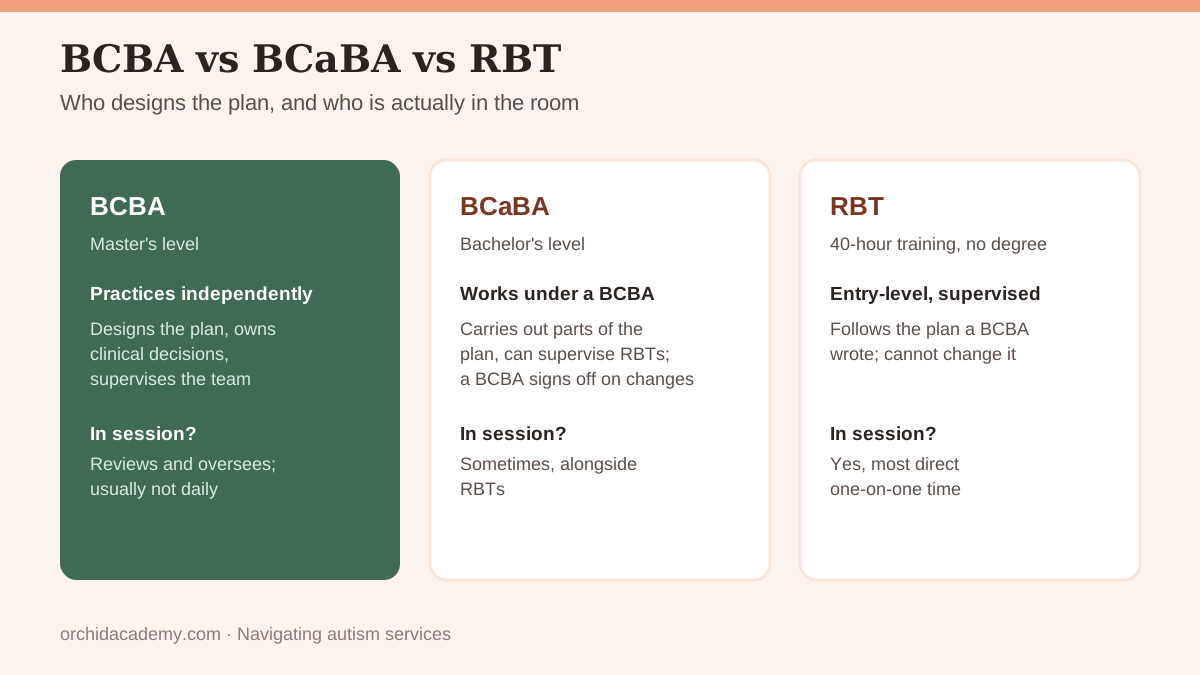
BCBA: Master’s-level and independently practicing, legally and clinically responsible for the treatment plan. Designs the program, reviews the data, and supervises everyone else on the case, but typically isn’t the person running daily sessions.
BCaBA (Board Certified Assistant Behavior Analyst): Bachelor’s-level, works under a BCBA’s supervision, and cannot practice independently. A BCaBA can carry out parts of a plan and supervise RBTs, but a BCBA has to sign off on any change to the program.
RBT (Registered Behavior Technician): The entry-level credential, built around a 40-hour training and a competency assessment rather than a degree. RBTs are the ones actually sitting with a child for most of a session, following the plan a BCBA wrote.
None of that means an RBT’s work is lower quality. A well-supervised RBT delivering a well-designed program is exactly how good ABA is supposed to run. Still, “my child’s team includes a BCBA” and “a BCBA is in the room” are two different claims, and it’s fair to ask which one is true for your case.
How to verify a specific person’s certification
Anyone can put “BCBA” in an email signature. Whether that claim is current is a matter of public record. The BACB maintains a Certificant Registry that lets you look up a specific name and see their certification status (active, inactive, or lapsed) along with any reportable disciplinary action tied to that credential. It takes about thirty seconds, and it’s the most useful check you can run before intake. If a provider bristles at the idea of you checking, that’s information too.
In Washington, check the state license too. Washington licenses behavior analysts separately from the national board. A BCBA who treats clients here also needs a Washington license as a licensed behavior analyst (LBA). Assistant analysts are licensed as LABAs, and technicians hold a state certified behavior technician (CBT) credential (RCW 18.380). You can look up any of them by name in the Department of Health’s license search. Insurers and Apple Health pay for services only from state-credentialed providers.
What to ask beyond “do you have a BCBA”
Our guide to questions for a new ABA provider covers the broader interview: approach to ABA, goal-setting, parent involvement, communication. Two questions specific to the BCBA role are worth pulling out on their own, because they’re the ones “we have BCBAs on staff” tends to paper over:
How many kids is this BCBA actually carrying? Caseload size varies a lot by clinic and by how much of the BCBA’s week goes to direct clinical work versus administration. There’s no single right number, but a BCBA stretched across 20-plus active cases is not going to know your child’s program the way one carrying eight or ten does.
How often does the BCBA personally observe sessions, versus reviewing data from a distance? The BACB’s minimum for supervising an RBT’s hours runs a few percent of that RBT’s direct time, a floor rather than a target. A parent-favorite red flag in this field, and a reasonable one, is a BCBA who’s a name on the paperwork but is rarely there. Ask specifically how many in-person or live-video observations happen per month, not just how often data gets reviewed on a spreadsheet.
How insurance usually connects you to one
In Washington, ABA almost always requires an autism diagnosis before insurance will authorize services. Our guide to why a diagnosis is needed for ABA walks through that process and the waitlists involved. Once a diagnosis is in hand, a provider runs a benefits check, gets authorization, and assigns a BCBA to complete the initial assessment and write the treatment plan. You generally don’t shop for a BCBA independently the way you’d pick a pediatrician; you pick a provider, and the provider assigns the BCBA, though a good clinic will still let you meet that person and ask questions before you commit to a schedule.
This is also where the “near me” instinct causes real friction. Diagnostic waitlists in Washington can already run months, and if a family spends more of that runway hunting for a specific independent BCBA rather than getting on a provider’s intake list, the clock keeps running in the background either way. Calling providers directly and asking who they’d assign, rather than searching for a solo practitioner, is usually the faster path to an actual start date.
What “near me” should mean here
ABA runs one of two ways: in-home, where the team comes to you, or center-based, where you bring your child to a clinic. “BCBA near me” implies you need to drive to one, but for in-home programs it’s often the reverse. The BCBA and the RBT travel to your address, so what needs to be “near you” is the provider’s service area, not a physical office.
If you’re searching for in-home support, a more useful search is your provider’s coverage map, not a map pin for an office you’ll never visit. If a center-based program is what you want, then yes, drive time to the clinic matters the way it would for any other appointment. Either way, the RBT delivering daily sessions needs to be local. The BCBA overseeing the case sometimes doesn’t. Some clinics run supervision partly over video, which isn’t automatically a red flag, but it’s worth asking about directly so you know what you’re getting.
Orchid Academy runs BCBA-led teams across its Washington locations (Bellevue, Issaquah, Bothell, Sammamish, Covington, Federal Way, and East Wenatchee), offering both in-home and center-based ABA. If you want to talk through caseload, supervision structure, or which BCBA would take your child’s case, contact our team or see the full list of Orchid locations.
Frequently asked questions
Does a BCBA need a license in Washington?
Yes. Washington requires behavior analysts to hold a state license, called a licensed behavior analyst (LBA), in addition to any BACB certification. Assistant analysts are licensed as LABAs, and technicians need a state certified behavior technician (CBT) credential. You can check all three in the Department of Health's free online license search.
When should a child see a behavior specialist?
For ABA, the usual starting point is an autism diagnosis, because in Washington insurance almost always requires one before it authorizes services. Once you have a diagnosis, a provider runs a benefits check, gets authorization, and assigns a BCBA to do the initial assessment. If you have concerns but no diagnosis yet, get on an evaluation waitlist and a provider's intake list at the same time.
Is ABA the same as a BCBA?
No. ABA, or applied behavior analysis, is the therapy. A BCBA, or Board Certified Behavior Analyst, is the credentialed clinician who designs the ABA treatment plan, reviews the data, and supervises the team. Most daily sessions are delivered by an RBT following the plan the BCBA wrote, so an ABA program includes a BCBA without the BCBA being in every session.
What is the difference between a BCBA and an RBT?
A BCBA holds a master's degree or higher, completed supervised fieldwork, passed a national exam, and can practice independently. An RBT holds an entry-level credential built on a 40-hour training and a competency assessment, and works under supervision. The BCBA owns the treatment plan and clinical decisions. The RBT sits with your child for most sessions and carries out that plan.
Can I choose my child's BCBA?
Usually you choose the provider, and the provider assigns the BCBA. A good clinic will still let you meet the BCBA before you commit to a schedule and ask about their caseload and how often they observe sessions. You can also look up any BCBA's certification status and reportable disciplinary actions in the BACB's free Certificant Registry.
Does a BCBA have to come to my home?
Not always. In in-home ABA, the RBT and BCBA travel to your address, so what matters is the provider's service area rather than an office location. Some clinics run part of the BCBA's supervision over video. That isn't automatically a problem, but ask how many in-person or live-video observations happen each month so you know what to expect.
See how our team can support your child
Keep exploring
- ABA therapy at Orchid Academy
Evidence-based autism therapy across our academies, homes, and schools.
- New autism diagnosis guide
First steps after a diagnosis: therapies, hours, siblings, and finances.
- Find an Orchid location
Issaquah, East Wenatchee, Bothell, Kirkland, Sammamish, Bellevue, Covington, Federal Way, and telehealth.
Related Articles
ABA Reauthorization: What Insurance Reviews and Why Hours Get Cut
ABA reauthorization decides whether therapy continues and at how many hours. What your plan reviews, why hours get cut, and what to do before the next review.
Oct 30, 2026 · 9 min read
Autistic Child Kicked Out of Daycare in Washington? What to Do This Week
If your autistic child was kicked out of daycare in Washington: what the rules require, your rights under the ADA, free evaluations, and full-day options.
Oct 30, 2026 · 7 min read
ABA Therapist Turnover: What's Normal and What Your Provider Owes You
ABA therapist turnover is common. What the research says, what a provider should do when your child's RBT leaves, and what to ask about staffing at intake.
Oct 23, 2026 · 9 min read