
Surviving Power Outages with a Child with Autism

We’ve sat through enough storms and multi-day outages to know the feeling. The routine is gone. Screens die. Dinner plans fall apart. Bedtime hits while the house is still dark. For a child with autism, that mix of sensory change and unpredictability can tip a hard day into a meltdown day.
Power outages hit our families in specific ways: sudden routine changes, sensory shifts (dark rooms, quieter or noisier than usual, no familiar device sounds), and a hard time explaining when things will go back to normal.
You do not need a perfect plan. You need a kit ready before the storm, and a short list of moves once the power drops.
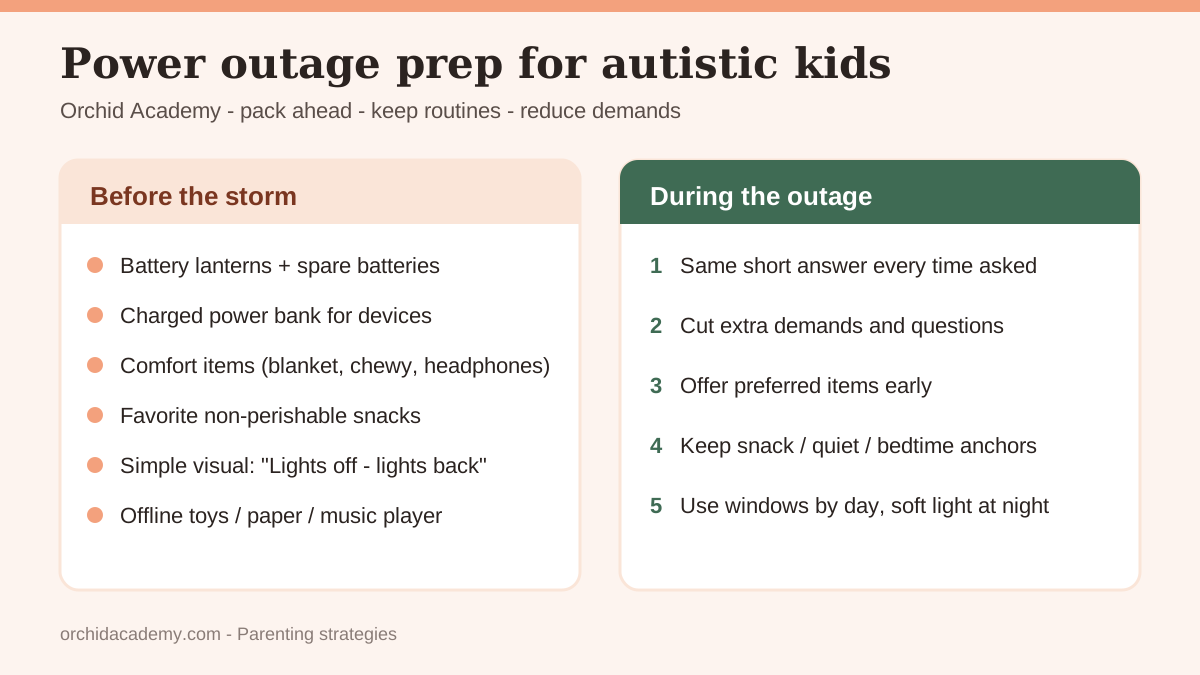
Build a power outage kit ahead of time
Keep a bin or bag in one spot so you are not hunting for items in the dark. Stock it with:
- Battery lanterns or flashlights (test them a few times a year)
- Extra batteries and a portable phone charger that stays topped up
- Noise-canceling headphones or preferred ear protection
- Comfort items: a weighted blanket, favorite stuffed animal, or soft hoodie
- Non-tech toys and activities: trains, sensory bins, bubbles, books, coloring
- Shelf-stable favorite snacks and a few preferred drinks
- A simple visual or written script you can point to (“Lights are off. Lights come back later.”)
If your child uses charged devices for regulation, decide now which ones get priority and pack the cords with the kit. Charge them as soon as weather alerts start, not after the outage begins.
We practice some of this in parent training so families are not inventing strategies mid-storm.
What to do when the power goes out
- Lower the demand load. Skip the long explanations and multi-step chores. Use short phrases: “Lights off. We stay inside. Snack next.”
- Bring out preferred items early. Do not wait for frustration. Stack reinforcement the way we talk about in preventing meltdowns during challenging times. Put more favorites out, ask for less, and offer more choices.
- Keep the pieces of the day that still work. Snack time, quiet time, and bedtime rituals can run without electricity. Same order, same language.
- Use natural light during the day. Sit near windows. At night, soft lantern light usually beats a bright flashlight in the face.
- Answer the same question the same way every time. If your child asks when the lights will come back, say, “The lights are off. They will come back.” Consistency reduces the scramble for a “better” answer that never satisfies.
Communication and sensory tips that help
Repetitive questions are usually information-seeking. Match the calm answer to a visual if your child uses one. If they are nonverbal, pair the same short phrase with the same gesture or picture each time.
Darkness, unfamiliar silence, or the hum of a generator next door can all be sensory stressors. Headphones, a familiar blanket fort, and keeping preferred textures within reach go further than talking a child through it.
Mealtime may not look normal. Favorite snacks are fine. Nutrition goals can wait until the fridge is cold again and everyone has slept.
If you need to leave for charging or warmth, preview the trip with a short social story or picture sequence before you pack the car. Surprise outings on top of an outage often push an already stressed child past their limit.
You will not get every outage “right.” Some days the kit helps and some days everyone is tired by 3 p.m. That is still a good day if you kept your child safe and yourselves as regulated as possible.
If power outages, storms, or other disruptions keep turning into crisis evenings, loop in your BCBA. We can build a family-specific plan, practice scripts, and decide what reinforcement looks like for your child before the next storm hits.
Contact Orchid Academy or reach out to your BCBA to get started.
See how our team can support your child
Dr. Autumn Flick, BCBA
Board Certified Behavior Analyst
Keep exploring
- Parent & family training
Coaching that fits your family's routines and goals.
- ABA therapy at Orchid Academy
How we build communication, independence, and daily living skills.
- Request a call back
Ask about programs that match your child's needs.
Related Articles
Social Skills for Teens With Autism: Friendships, Boundaries, and Real-Life Practice
Practical, age-respectful social skills for autistic teens: friendships, group chats, boundaries, self-advocacy, and ways to practice without forced masking.
Sep 22, 2026 · 3 min read

How Storytelling Supports Literacy and Learning for Children
How shared storytelling builds vocabulary, sequencing, and social understanding for autistic kids, and how to use personalized stories alongside ABA goals at home.
Aug 22, 2026 · 4 min read

Picky Eaters with Autism: Embracing Mealtime with Compassion
Why picky eating is common in autism, and concrete steps for introducing new foods without turning dinner into a fight.
Feb 2, 2025 · 2 min read