
Age-Appropriate Music for Children with Autism

Music shows up in regulation, transitions, and play for a lot of autistic kids. It can also get stuck on the same five nursery rhymes until every adult in the house is done. Age-appropriate music means songs that fit the child’s stage without overstimulating them, and that you can stand to hear on repeat.
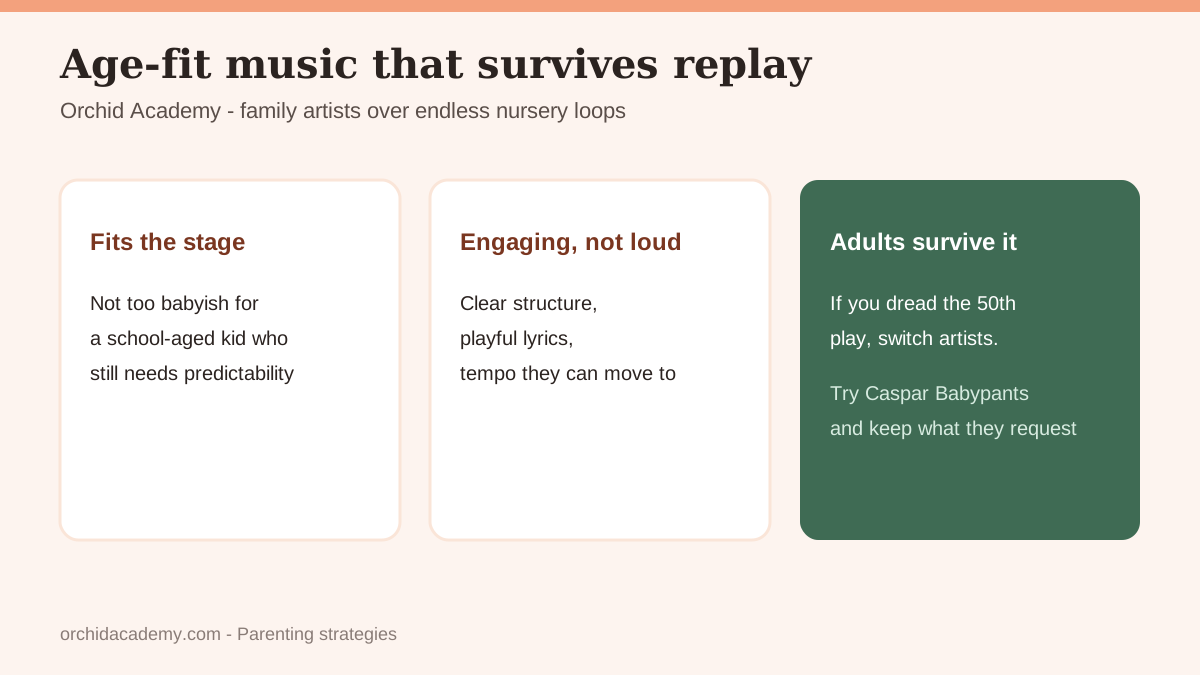
What “age-appropriate” means here
Look for music that is engaging without a wall of noise. Simple structure, clear lyrics or playful nonsense, and a tempo your child can move to. Baby-only singalongs can feel babyish to a school-aged learner who still needs predictable songs. Adult radio can be too dense. Family artists who write for kids and adults sit in the middle.
Music therapy is its own clinical service. This post is about what you put on in the car and during play, not a substitute for therapy.
Case in point: Caspar Babypants
I have watched learners (and my own kids) lock onto Caspar Babypants. I found the catalog as a special education teacher hunting for something other than the same three nursery tapes. Chris Ballew, who sang in The Presidents of the United States of America in the ’90s, moved into family music later. The songs are upbeat, the videos are weird in a kid-friendly way, and adults can survive the fiftieth play.
Orchid’s frequent replay list:
Try a few artists in this lane and keep the ones your child requests. Pair preferred music with transitions or calm-down routines if that already works in your house. For disruption days when you need every preferred item out, see preventing meltdowns during challenging times.
See how our team can support your child
Dr. Autumn Flick, BCBA
Board Certified Behavior Analyst
Keep exploring
- Parent & family training
Coaching that fits your family's routines and goals.
- ABA therapy at Orchid Academy
How we build communication, independence, and daily living skills.
- Request a call back
Ask about programs that match your child's needs.
Related Articles
Social Skills for Teens With Autism: Friendships, Boundaries, and Real-Life Practice
Practical, age-respectful social skills for autistic teens: friendships, group chats, boundaries, self-advocacy, and ways to practice without forced masking.
Sep 22, 2026 · 3 min read
How Storytelling Supports Literacy and Learning for Children
How shared storytelling builds vocabulary, sequencing, and social understanding for autistic kids, and how to use personalized stories alongside ABA goals at home.
Aug 22, 2026 · 4 min read
Picky Eaters with Autism: Embracing Mealtime with Compassion
Why picky eating is common in autism, and concrete steps for introducing new foods without turning dinner into a fight.
Feb 2, 2025 · 2 min read