
Autism Preschool Near Me: Comparing the Four Real Options in Washington
Searching for an autism preschool near me returns four different things, and the results page won’t tell you which is which. A district developmental preschool, an ECEAP or Head Start classroom, a community preschool willing to include your child, and a center-based ABA academy can all appear side by side. They’re funded differently, they admit children differently, and only some of them are on a clock you can miss.
Option 1: Developmental preschool through your school district
This is special education, delivered at a public school, starting at age 3. It’s free. Your child qualifies through an evaluation by the district, not by a doctor, and eligibility runs under Part B of the Individuals with Disabilities Education Act.
A child qualifies if they have a disability in one of 14 federal categories (autism and developmental delay are both on the list), the disability significantly affects them at school, and they need specialized instruction. If your child qualifies, the team writes an IEP. Our parent’s guide to the sections of an IEP walks through what’s in that document.
Two things families routinely get wrong here. First, a medical autism diagnosis does not automatically qualify a child for an IEP; educational impact has to be established separately. Second, if your child doesn’t qualify for an IEP, they may still be eligible for accommodations through a Section 504 plan.
Option 2: ECEAP or Head Start
ECEAP (Washington’s Early Childhood Education and Assistance Program, said out loud as “E-cap”) and Head Start are free, income-eligible preschool programs run through DCYF. They’re not autism-specific, but they serve children with disabilities, and a transition plan can name one as part of the plan.
They’re often the right answer for a child who needs a peer-rich classroom more than they need clinical intensity, and they’re frequently paired with district services rather than chosen instead of them.
Option 3: A community preschool with inclusion support
A regular neighborhood preschool, with your child included and supported. Quality varies enormously and depends almost entirely on the individual teacher and the director’s willingness. Some children thrive here. Others need more structure than a 1-to-12 classroom can offer, and the placement quietly fails over a few months.
If you’re considering this, ask the director directly how many children with IEPs they currently serve, and what happens on a hard day. The answer to the second question tells you more than the answer to the first.
Option 4: A center-based ABA academy
A full-day program built around an individualized ABA treatment plan, supervised by a BCBA, and funded through health insurance rather than tuition or property taxes. The schedule looks like preschool. The underlying structure is clinical: your child works from a treatment plan with measurable goals, and the staffing ratio is far richer than a classroom.
This is the option that most often confuses families, because it looks like daycare from the parking lot. Our post on ABA as a daycare and preschool alternative describes what a full day contains. If a program has already asked your child to leave, read what to do if your autistic child is kicked out of daycare.
For Eastside families considering this setting, Creekside Academy’s early-learning ABA program in Issaquah is the most relevant Orchid location to compare on a tour.
The clock most families don’t know about
If your child is under 3 and receiving early intervention through Washington’s Early Support for Infants and Toddlers program, those services end on their third birthday. They stop entirely rather than tapering off.
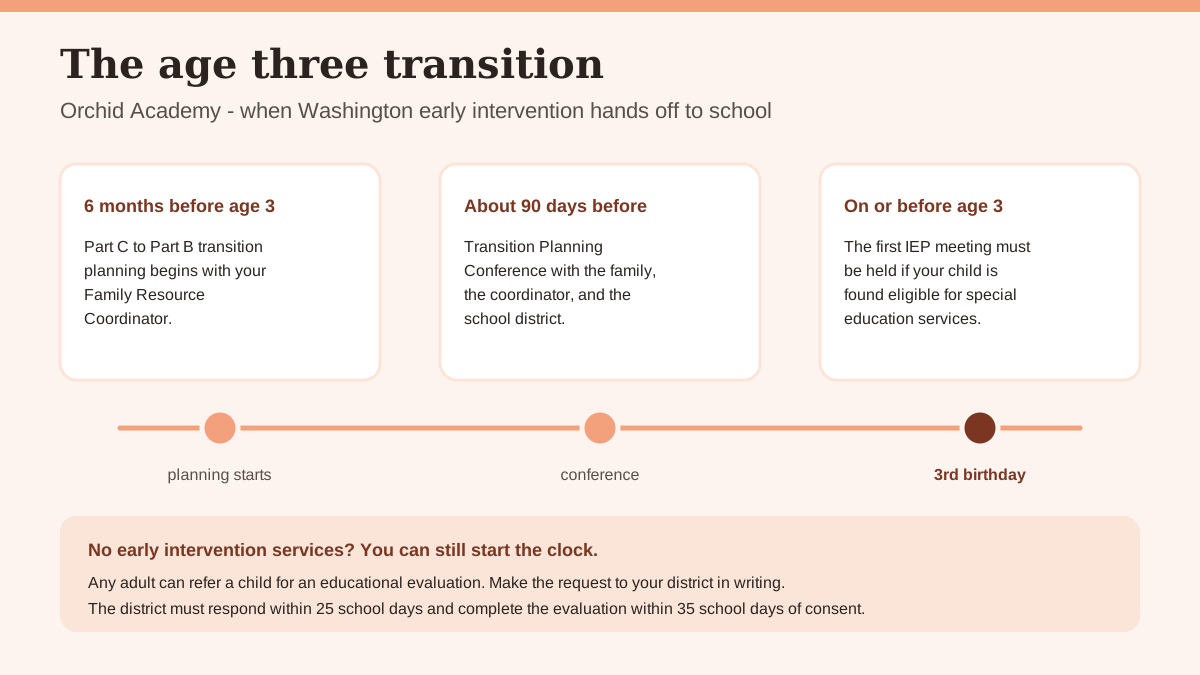
The handoff is called Part C to Part B transition, and it has real deadlines:
- Six months before the third birthday, transition planning is supposed to begin.
- About 90 days before, a Transition Planning Conference is held with the family, the Family Resource Coordinator, and the district.
- The first IEP meeting must happen on or before the child’s third birthday, if the child is found eligible.
If your child never had ESIT services, the path is still open. Anyone can refer a child for an educational evaluation, and best practice is to make the request to the district in writing. Once you do, the district must respond within 25 school days, and if it agrees to evaluate, it must complete the evaluation within 35 school days of your consent. Districts also carry a Child Find obligation to seek out and evaluate children with known or suspected disabilities, which means you don’t need anyone’s permission to start.
Those counts are school days, so a request made in mid-June does not start a 25-day clock that expires in July.
Can you do more than one?
Yes, and it’s common. A child might attend developmental preschool in the morning on an IEP and a center-based ABA program in the afternoon on insurance, because the two are funded by different systems and answer different needs. School is where peer access and educational goals live. ABA is where individualized skill-building and behavior support live.
Your child’s stamina is the practical limit. A schedule that looks balanced on a spreadsheet can be too much for a 3-year-old, and the best signal is what happens at pickup. Our guide to choosing the right number of ABA hours covers how to think about total load.
What to ask on a tour
Skip the curriculum brochure. Ask these:
- Who is with my child minute to minute, and what is their credential? In an ABA setting this is usually an RBT; in a classroom it may be a paraeducator.
- What is the ratio, and what is it at the hardest part of the day? Ratios quoted for circle time are not ratios at transitions.
- What happens when my child has a hard day? Listen for a specific plan, not a philosophy.
- How will I know if this is working? Ask what gets measured and how often you’ll see it.
- What does the handoff to kindergarten look like? A good program is already thinking about the exit.
What “near me” should mean
For a district developmental preschool, “near me” is decided for you: it’s your resident district, and you don’t get to shop across boundaries. For ECEAP and Head Start, it’s about which sites have open slots, which shifts through the year. For a private preschool or an ABA academy, drive time is a real factor, because you’re doing it twice a day, five days a week, for years. A program 35 minutes away that’s a perfect fit often loses to one 10 minutes away that’s merely good, and that’s a rational trade.
The exception is in-home ABA, where the team comes to you and the only thing that needs to be near you is the provider’s service area.
Orchid Academy runs full-day, center-based ABA academies for children ages 2 to 15 in Issaquah and East Wenatchee, plus in-home ABA across Bellevue, Bothell, Kirkland, Sammamish, Covington, Federal Way, and Auburn. If Issaquah is the drive, Creekside Academy is the early-learning option and Maple Street Academy focuses on school readiness. ABA as a daycare and preschool alternative and autism in Issaquah compare them in more detail. Our school readiness program focuses on the classroom routines and group participation that come before preschool and kindergarten, and our early intervention services support the youngest children.
If your child is approaching their third birthday and you’re not sure which of the four options fits, request a call back. We’ll walk through it with you, including the cases where the district program is the better answer.
Frequently asked questions
Should autistic children go to preschool?
Many do, but the right setting depends on the child. Some autistic children do well in a peer-rich classroom such as ECEAP, Head Start, or a community preschool with inclusion support. Others need the structure and staffing of a district developmental preschool or a center-based ABA program, and many families combine a school program with ABA. Your child's stamina and how they are doing at pickup are the best guides.
Do autistic kids get free pre-K?
Often, yes. If your school district finds your child eligible for special education, developmental preschool is free starting at age 3, delivered under an IEP. A medical autism diagnosis does not qualify a child on its own, because the district has to establish educational impact. ECEAP and Head Start are also free for families who meet the income rules, and they serve children with disabilities.
At what age can an autistic child start district preschool?
Age 3. District developmental preschool is special education under Part B of IDEA, and it starts at age 3. If your child is in Washington's ESIT early intervention program, those services end on the third birthday, and the first IEP meeting must happen on or before that date if your child is eligible. Transition planning is supposed to begin six months ahead.
How do I get my child evaluated for developmental preschool?
Make the request to your school district in writing. Anyone can refer a child, and districts have a Child Find duty to evaluate children with known or suspected disabilities. Once you ask, the district must respond within 25 school days, and if it agrees to evaluate, it must finish within 35 school days of your consent. Those are school days, so summer breaks slow the clock.
See how our team can support your child
Keep exploring
- Issaquah ABA as a preschool alternative
Full-day hours at Creekside and Maple Street.
- Autism in Issaquah
Which academy to tour if Issaquah is the drive.
- ABA therapy at Orchid Academy
Evidence-based autism therapy across our academies, homes, and schools.
Related Articles
ABA Reauthorization: What Insurance Reviews and Why Hours Get Cut
ABA reauthorization decides whether therapy continues and at how many hours. What your plan reviews, why hours get cut, and what to do before the next review.
Oct 30, 2026 · 9 min read
Autistic Child Kicked Out of Daycare in Washington? What to Do This Week
If your autistic child was kicked out of daycare in Washington: what the rules require, your rights under the ADA, free evaluations, and full-day options.
Oct 30, 2026 · 7 min read
ABA Therapist Turnover: What's Normal and What Your Provider Owes You
ABA therapist turnover is common. What the research says, what a provider should do when your child's RBT leaves, and what to ask about staffing at intake.
Oct 23, 2026 · 9 min read