
Autism Summer Tips: Travel, Outdoor Safety, and a Break Parents Can Survive

These autism summer tips are for parents who are dreading the break as much as looking forward to it. When school stops, every meal, transition, and safety risk comes home, and the camps that work for other families may not take a child who elopes or needs 1:1 support. The goal isn’t a magical summer. It’s a week a tired adult can actually run, plus outings and trips your child has practiced for.
Plan a summer week you can actually run
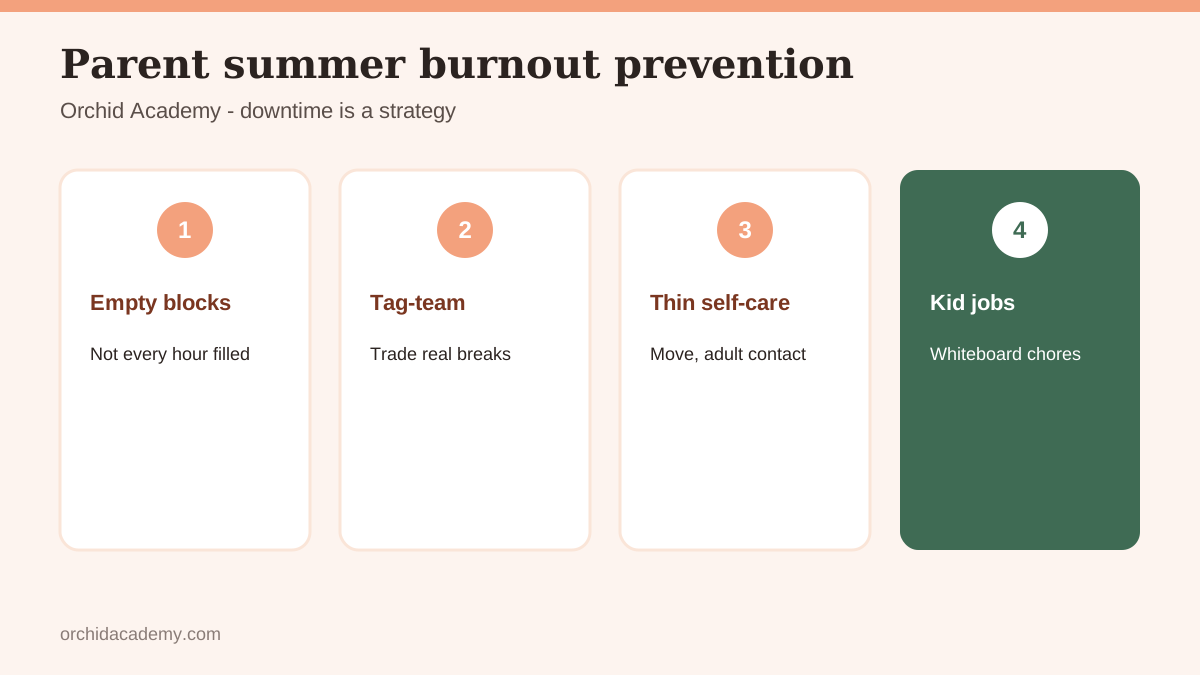
Pick three anchors and leave the rest of the week empty:
- One outdoor block: a walk, the backyard, or a park (safety rules below).
- One home-skills block: chores, food prep, or a short learning session. Teaching chores is enough curriculum.
- One preferred deep dive: trains, water play, or the tablet on a timer.
A whiteboard job list and short timed blocks (outside, then reading) give the day shape without you narrating every minute. For screens, a timer and a first-then (“outside, then show”) are enough.
Protect your own time. If two adults are in the house, put each person’s time off on the calendar in ink. A “we’ll play it by ear” summer is how one adult becomes the default staff. Keep a thin self-care line: one conversation with another adult, 20 minutes of movement, and one protected block that’s yours.
Give helpers a job. “Let us know if you need anything” help doesn’t show up. “Two hours Saturday morning” does. Washington families often piece together relatives on a written schedule, DDA respite if they’re enrolled, and inclusion camps that confirm 1:1 staffing in writing before you pay.
Keep ABA going. Pausing therapy for two months so your child can “just be a kid” sounds kind, but it often costs the skills you spent the year building. Ask your BCBA about a summer hour band you can staff. Daytime sessions are often easier to get when school is out.
Outdoor safety: boundaries, wandering, and heat

Name the physical boundary. “Stay on the bark” works better than “stay on the playground.” On a trail, use an arm’s-length rule: “Put your arm out. Can you touch me?” If not, move closer. You stay in contact without a constant fight over holding hands.
Plan for wandering. Many autistic children run toward interesting things (water, parking lots, dogs, the next trail marker) without checking that an adult is still with them. If your child has left a store, yard, or park before, treat the next outing as a safety outing: keep it short, choose a fenced playground over an open trail, bring a second adult, and put an ID bracelet with your phone number on your child. A wearable tracker can help, but test it at home first; it doesn’t replace supervision. Water gets its own watcher. Read water safety for autistic kids before the first pool or lake day.
Practice sun gear before the hot day. Two minutes in a hat during tablet time beats a 20-minute fight in a parking lot. Stick or spray sunscreen is often easier than thick lotion; do arms first and the face last. Put hat, sunscreen, and water on a picture card by the door.
Build in breaks and water. A blanket or travel seat becomes “the place we eat and reset.” Heat plus a new place drains regulation fast. Bring more water than you think you need, eat in the shade, then decide whether to keep going. Leaving while things are still okay is a skill.
The backyard counts. So does a 15-minute loop around the block. For park picks with fences and quiet corners, see autism-friendly parks on the Eastside and sensory-friendly activities near Seattle.
Summer travel with an autistic child
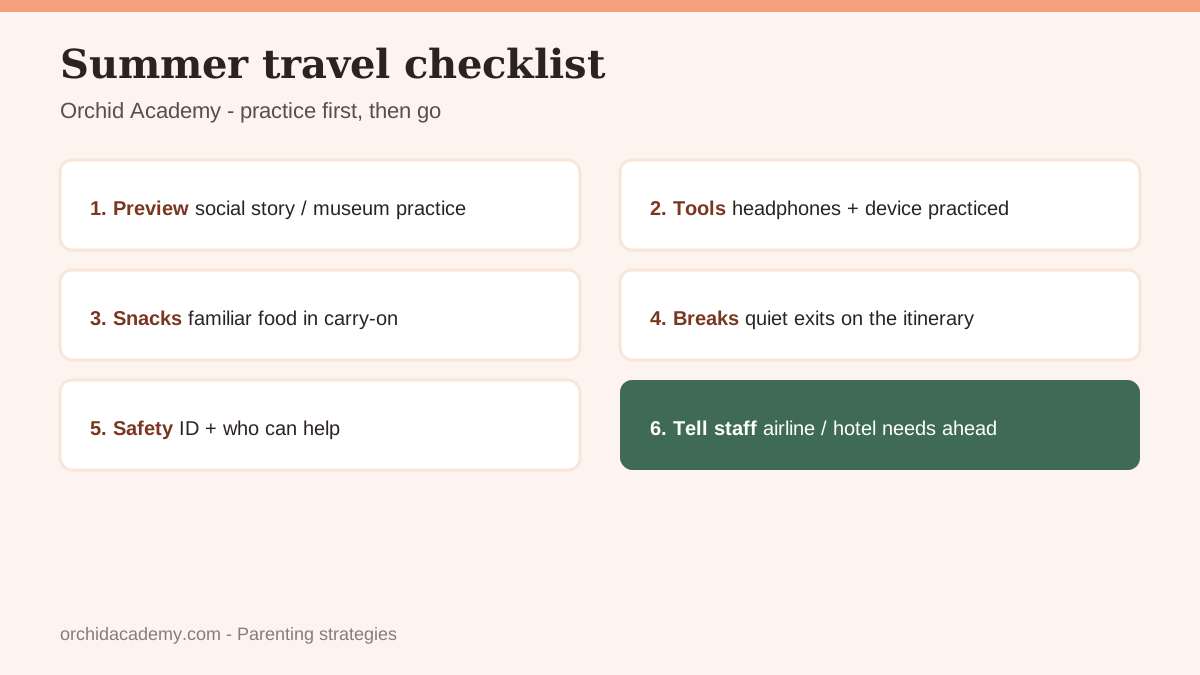
- Preview the places. Use social stories for the airport, plane, hotel, or attraction. Locally, the Museum of Flight runs sensory-friendly days, which are a low-stakes way to make planes familiar.
- Load the device and practice the headphones at home, so they aren’t a new demand on travel day.
- Keep the regulation kit in the carry-on: weighted lap item, chewy, favorite toy, noise protection.
- Bring familiar snacks, enough for delays.
- Schedule breaks into the itinerary. Crowded attractions need exits, not endurance contests.
- Cover safety: an ID bracelet or card with your number, and practice in advance who to ask for help (gate agent, flight attendant, uniformed officer).
- Choose lodging for sleep: a quiet floor, blackout curtains, and a fridge for meds or preferred foods.
- Tell the airline and hotel ahead of time. Call TSA Cares 72 hours before a flight for extra screening time.
Waiting, security lines, and bathrooms in new places can all be practiced in ABA sessions. Ask for a travel block four to six weeks before the trip. The airport and family-visit detail in the autism holiday tips applies to summer trips too. For weddings and big summer events, see weddings and summer events with an autistic child.
If you want help planning summer ABA hours or a travel unit with a BCBA, request a call back or read about ABA therapy at Orchid.
Frequently asked questions
Should we keep ABA therapy over the summer?
Ask your BCBA, but many learners lose skills over a long break, especially in communication and toileting. A reduced summer schedule is usually smarter than stopping completely, and daytime hours are often easier to staff when school is out.
How do I keep my autistic child from wandering off outdoors?
Name a concrete boundary ('stay on the bark'), use an arm's-length rule on trails, add an ID bracelet with your number, and give water its own dedicated adult. If your child has eloped before, start with fenced playgrounds and short outings.
My child only lasts two minutes outside. Is that a failure?
No. Two minutes on the grass with a clean exit is a successful outing. Lengthen it later.
Is it okay if we do almost nothing this summer?
Yes. A safe backyard and a consistent bedtime beat a packed activity spreadsheet you can't staff.
See how our team can support your child
Dr. Autumn Flick, BCBA
Board Certified Behavior Analyst
Keep exploring
- Parent & family training
Coaching that fits your family's routines and goals.
- ABA therapy at Orchid Academy
How we build communication, independence, and daily living skills.
- Request a call back
Ask about programs that match your child's needs.
Related Articles
Autism Holiday Tips: Gatherings, Travel, and Decorating Without the Meltdown
Autism holiday tips from Orchid's BCBAs: pick the events that matter, prep gatherings with a quiet room and exit rule, travel with practiced tools, and decorate in a sensory-friendly way.
Nov 20, 2026 · 6 min read
Social Skills for Teens With Autism: Friendships, Boundaries, and Real-Life Practice
Practical, age-respectful social skills for autistic teens: friendships, group chats, boundaries, self-advocacy, and ways to practice without forced masking.
Sep 22, 2026 · 3 min read

How Storytelling Supports Literacy and Learning for Children
How shared storytelling builds vocabulary, sequencing, and social understanding for autistic kids, and how to use personalized stories alongside ABA goals at home.
Aug 22, 2026 · 4 min read