
Autism Holiday Tips: Gatherings, Travel, and Decorating Without the Meltdown
These autism holiday tips come from what works for Orchid families: do fewer events, prepare for the ones you keep, and decide in advance what counts as a win. Holidays stack noise, new food, crowded rooms, travel, and a broken routine on top of each other. That pile is hard on many autistic kids. You don’t need a perfect holiday. You need a short list, a preview, and an exit plan.
Start by choosing which holidays matter
Family and culture tend to assume you’ll do every holiday the usual way. You don’t have to. Skipping events that overwhelm your child is allowed, and it frees up energy for the traditions that matter to your household.
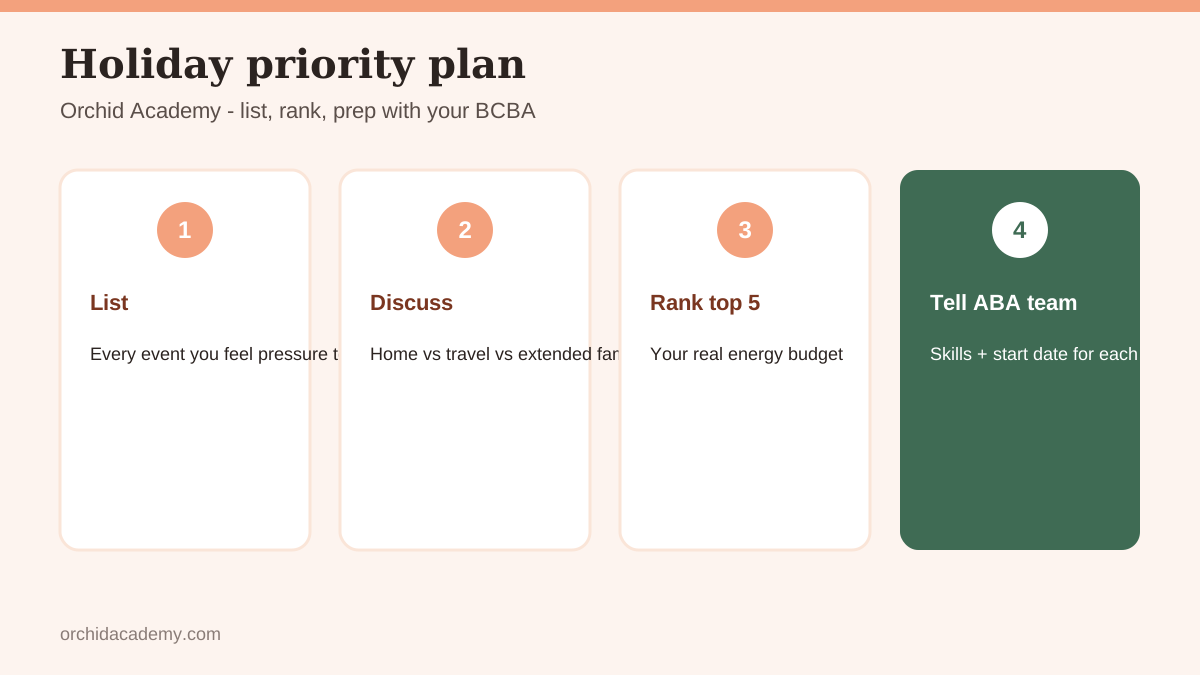
- List everything. Thanksgiving, religious holidays, birthdays, school concerts, parties, trips.
- Ask the same questions for each. At home, with friends, or with extended family? Does it require travel? Is the travel worth it this year?
- Rank your top five. That list is your energy budget for the season. The rest can shrink, move home, or rotate every other year.
- Define the win. One sentence per event: “Success is 20 minutes at the table and opening two gifts.” When you hit it, leave on a win. Staying two more hours “since it’s going well” usually costs you at bedtime.
If you and your partner rank differently, each adult gets one non-negotiable and the rest is up for discussion. Hosting at home helps when you can manage it, because you control the noise, the food, and the door. Visiting three houses in one day counts as three events.
Holiday gatherings: preview, quiet room, exit rule
Before you go (or before people arrive):
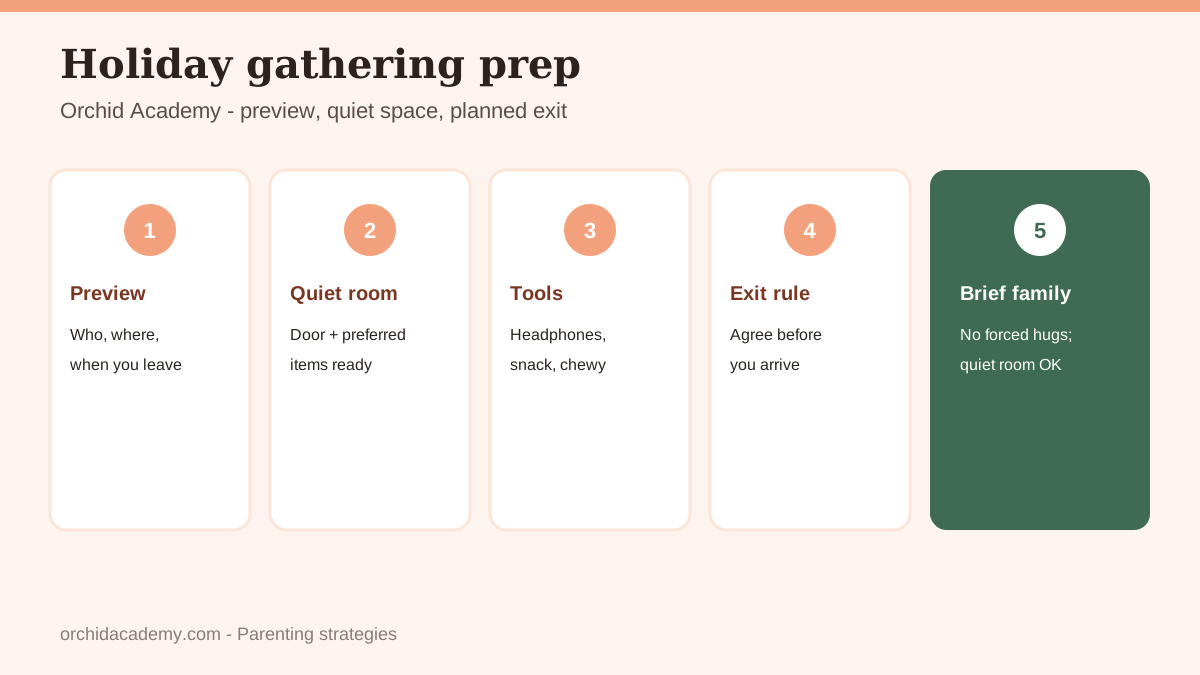
- Preview the day. Use a visual schedule or a short social story: who will be there, where you’ll sit, when you’ll leave. Use the same words every time your child asks.
- Pick a quiet room. A bedroom or den with the door closed beats “tough it out in the living room.” Stock it with a preferred toy, a book, or headphones.
- Pack regulation tools. Noise-canceling headphones, a chewy, a familiar snack, or a weighted lap pad if you use one.
- Set the exit rule in advance. For example: “If headphones are on for 10 minutes and it’s still too much, we go to the car.” Tell your partner the rule so you aren’t negotiating mid-meltdown.
Brief the relatives in writing. You don’t owe anyone a speech. One paragraph in a group text is enough:
“We’re doing Thanksgiving at home this year, 4 to 6 p.m. We’ll leave if it gets too loud. Please skip surprise hats and ‘just try it’ with food. A quiet room with the door closed helps. If you’d like to see us on a different day, Tuesday afternoon works better than the holiday itself.”
If someone takes it personally, repeat the plan. You don’t need to debate autism in the comments.
During the gathering, keep familiar adults nearby. Offer low-key activities, like a puzzle at the kids’ table, a simple craft, or a walk outside, instead of only loud group games. A flexible schedule beats a rigid photo timeline. If the day tips into overwhelm in public, use the short moves in handling a public meltdown.
Afterward, jot down what worked: they used the quiet room once, you left before dessert, a cousin played trains for twenty minutes. Keep that list for next year.
Holiday travel with an autistic child
Aim for a trip your child can get through with tools they’ve already practiced.
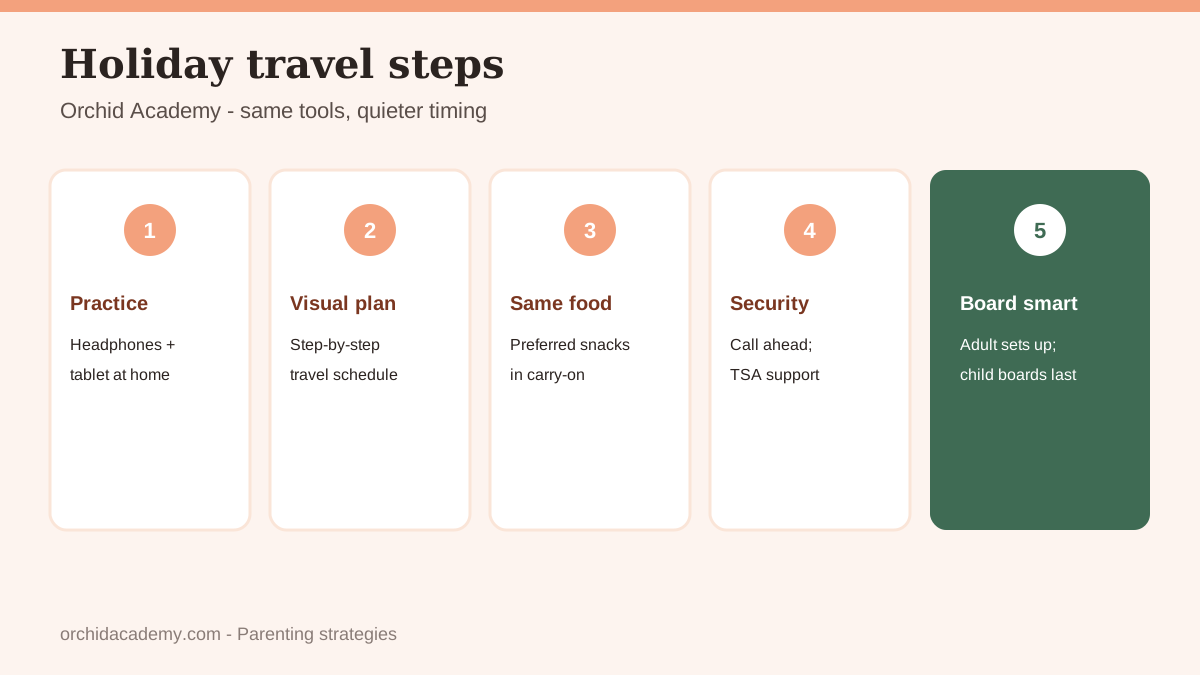
Practice before travel day. Have your child wear the headphones with the tablet or music you’ll use on the plane. Try a sensory blanket or lap pad in the car first. Ask your BCBA for a visual travel schedule and a social story.
Pack for sameness. Put the comfort item in the carry-on. Bring familiar snacks rather than counting on airport pizza, and the same water bottle if that matters. Keep the kit within reach at security and at the gate.
Airports and TSA. TSA Cares is a free helpline that can arrange extra time and a quieter screening when you call 72 hours ahead. Ask the airline’s disability desk to note the reservation (extra boarding time, a bulkhead seat, a request not to touch your child without asking). With two adults, send one ahead to set up the seats while the other boards last with your child. That alone prevents a lot of gate meltdowns. If your child won’t walk the jetway, practice a first-then (“walk, then tablet”) at home and at the grocery store first.
Car trips count as travel. Pack the same snacks. Plan stops you can leave quickly, like a rest area rather than a crowded restaurant. Download shows ahead of time instead of streaming them; the signal dies in the mountains. Agree ahead of time who drives and who handles your child if things go sideways.
The destination is a second trip. New beds, new smells, and relatives who hug first and ask later. Use the gathering plan above, and keep bedtime within an hour of home. A ruined second day often starts with a late first night.
Sensory-friendly holiday decorating
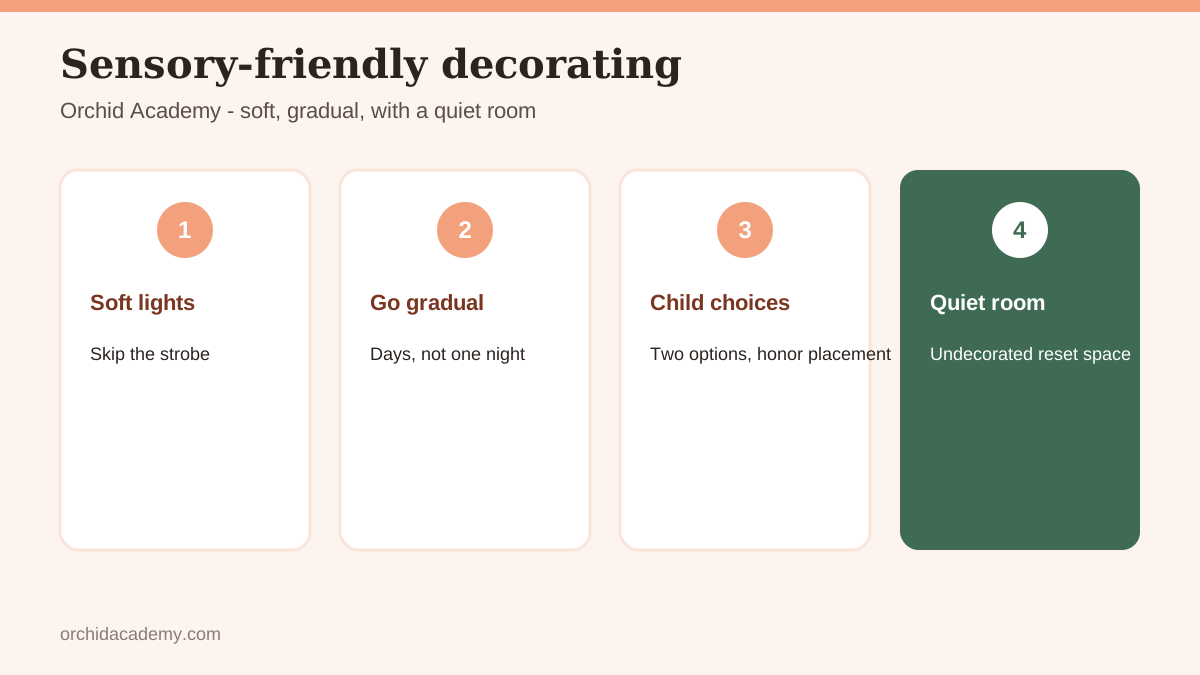
You can still decorate. Change how much, how fast, and what it’s made of.
- Lights: warm-white LEDs on a steady setting, not blinking or color-cycling. Put them on a timer, and keep an off switch you can reach without crawling under the tree.
- Smell and sound: skip pine sprays, simmer pots, and scented candles if smells are a known issue. If you play music, keep it to one room, with a way for your child to ask for it off.
- Go gradual: one shelf or one section of the tree a day. Put take-down day on the visual schedule too, such as “Lights come down January 2 after breakfast.”
- Real choices: two ornament options and one place to hang them. Honor the spot your child picks.
- Materials that survive a hard day: felt, wood, fabric, and plastic. Keep glass and sentimental pieces out of reach or in the box this year. Skip tinsel and small ornaments if your child mouths objects.
- Keep one room undecorated. Usually that’s your child’s bedroom, so it stays the reset space.
A small tree in a corner beats a floor-to-ceiling one in the walkway. If the tree itself is too much, decorate a shelf or a single door.
Thanksgiving and gratitude, the low-pressure way
Gratitude practice can be concrete and short. In November, Orchid classrooms fill a “Thankful 30” wall: each day, a child adds a leaf with a word, picture, or drawing of something they’re glad about. At home, one leaf at dinner works better than a round of speeches around the table.
Ask your BCBA to build a holiday unit
Give your BCBA your ranked list in October, not the week of. Good holiday goals are small and have dates attached: sit for a 20-minute meal, greet one relative, open two gifts, wear headphones at a gathering, use a public bathroom, hang an ornament. Families who never traveled before services often send us photos from trips that worked the next year. What usually changed was practice and a plan. That planning is fair game for parent training.
Halloween has its own guide: trick-or-treating with an autistic child. For gatherings outside the holiday season, see weddings and summer events.
If you’d like help building a holiday plan with a BCBA before the next big gathering, request a call back or explore ABA therapy at Orchid.
Frequently asked questions
How do I prepare my autistic child for a holiday gathering?
Preview the day with a visual schedule or short social story, set up a quiet room with headphones and a preferred toy, decide an exit rule in advance, and send relatives a three-line text about what helps. Practice the hard parts, like sitting for a meal or opening gifts, four to six weeks ahead.
Should we skip holiday travel this year?
If the trip isn't on your top-five list, yes. Video calls exist, and relatives can visit on a day you control. If you do travel, practice headphones and the carry-on kit at home first and call TSA Cares 72 hours before a flight.
Earplugs or noise-canceling headphones?
Whichever your child will actually wear. Most kids we see tolerate noise-canceling headphones better than foam plugs. Test them on a noisy car ride before the trip.
What if my child doesn't want any decorations?
Skip decorating, keep a quiet room, and put the energy into the one or two traditions on your priority list. Relatives can decorate their own houses.
Can ABA sessions target holiday skills?
Yes. Waiting, wearing headphones, sitting through a meal, unwrapping a gift, hanging an ornament, using an unfamiliar bathroom, and sitting in a car seat after a long day are all fair goals. Ask your BCBA for a short holiday unit four to six weeks out, not the week before.
See how our team can support your child
Dr. Autumn Flick, BCBA
Board Certified Behavior Analyst
Keep exploring
- Parent & family training
Coaching that fits your family's routines and goals.
- ABA therapy at Orchid Academy
How we build communication, independence, and daily living skills.
- Request a call back
Ask about programs that match your child's needs.
Related Articles
Autism Summer Tips: Travel, Outdoor Safety, and a Break Parents Can Survive
Autism summer tips for parents: plan a week a tired adult can run, travel with practiced tools, keep outdoor outings safe from wandering and heat, and protect ABA hours over the break.
Nov 20, 2026 · 4 min read
Social Skills for Teens With Autism: Friendships, Boundaries, and Real-Life Practice
Practical, age-respectful social skills for autistic teens: friendships, group chats, boundaries, self-advocacy, and ways to practice without forced masking.
Sep 22, 2026 · 3 min read
How Storytelling Supports Literacy and Learning for Children
How shared storytelling builds vocabulary, sequencing, and social understanding for autistic kids, and how to use personalized stories alongside ABA goals at home.
Aug 22, 2026 · 4 min read