
How Much Does ABA Therapy Cost in Washington State
How much does ABA therapy cost? For most Washington families it’s $120 to $150 an hour before insurance, and far less once coverage, Apple Health, or a state mandate gets involved. Which number applies to your family depends on three things: whether you’re paying privately, whether your insurance plan is state-regulated or self-funded, and whether your child qualifies for Apple Health. Those three paths lead to very different bills.
This post is about the number itself: what drives it up or down, what the math looks like at different weekly hour totals, and what Washington’s insurance rules actually require. For the vocabulary on your EOB or a walkthrough of the authorization process, our insurance terms glossary and insurance journey guide already cover that ground.
The national hourly rate, and why it’s wide
Private-pay ABA therapy in the U.S. generally runs $120 to $150 per hour, a range corroborated across multiple provider cost breakdowns. The figure blends two different rates. A Board Certified Behavior Analyst (BCBA) bills more per hour for assessment, supervision, and treatment-plan design; a Registered Behavior Technician (RBT) delivering direct one-on-one sessions bills less. Most treatment plans mix both: a handful of BCBA supervision hours each month layered under many more RBT direct-service hours. Location matters too. Providers in higher cost-of-living metro areas like the Seattle Eastside tend to sit at the upper end of that range.
The other reason the range is wide is intensity. ABA is prescribed in weekly hours based on a child’s evaluation, and that number varies enormously by case:
- 10 hours/week (focused model): roughly $1,200 to $1,500/week, or about $62,400/year before any insurance offset
- 20 hours/week: roughly $2,400 to $3,000/week, or about $124,800/year
- 30 to 40 hours/week (comprehensive model, common for younger children early in treatment): annual private-pay totals run about $187,200 to $249,600 a year at $120/hour, and up to $312,000 at $150/hour, depending on the exact hourly rate and weekly hour total (see a similar breakdown)
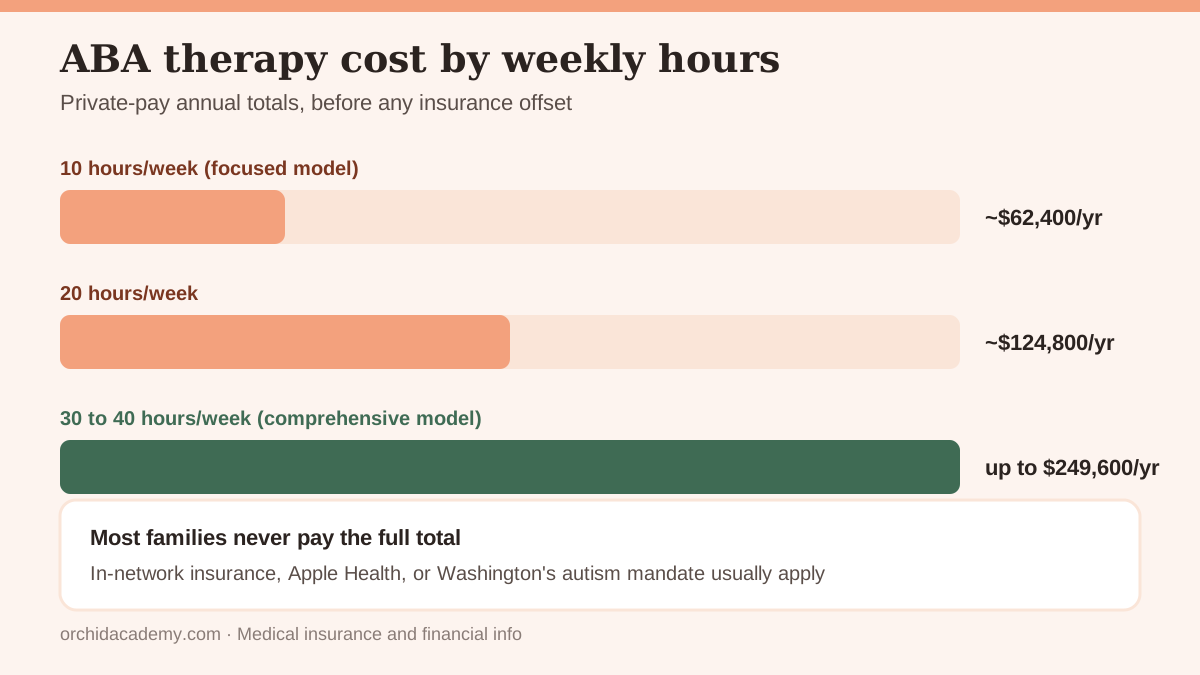
Here is the same math as a weekly and yearly table, using the $120 to $150 hourly range and 52 weeks of therapy:
| Hours per week | Weekly cost | Yearly cost at $120/hour | Yearly cost at $150/hour |
|---|---|---|---|
| 10 (focused) | $1,200 to $1,500 | $62,400 | $78,000 |
| 20 | $2,400 to $3,000 | $124,800 | $156,000 |
| 30 | $3,600 to $4,500 | $187,200 | $234,000 |
| 40 (comprehensive) | $4,800 to $6,000 | $249,600 | $312,000 |
These are private-pay totals before any insurance. A real bill depends on the mix of BCBA and technician hours and how many weeks your child actually attends, so treat the table as an estimate, not a quote.
Those are the numbers that show up when parents compare notes online, and they’re also why almost no family pays full private-pay rates for a full course of comprehensive treatment. The rest of this comes down to which coverage path you’re on.
Private pay vs. in-network vs. out-of-network: the actual math
Private pay means the $120–$150/hour rate is your rate, full stop. No prior authorization, no claims paperwork, no waiting on a benefits review, but also none of the cost-sharing protection insurance provides. Some families choose this deliberately for flexibility (no session caps, no reauthorization cycle) even when they have coverage, usually for a portion of their hours rather than all of them.
In-network means your insurer has a contracted “allowed amount” with the provider that’s typically far below the private-pay rate, and you owe only your plan’s share of that: deductible, then copay or coinsurance, until you hit your out-of-pocket maximum. This is where most of the real savings happen. Our deductibles and HSAs post walks through why the first few months of a plan year, when the deductible resets, are usually the most expensive stretch even with good coverage.
Out-of-network sits in between and catches families off guard. Your provider still bills their full rate, but your insurer reimburses based on what it considers a “reasonable” out-of-network amount, often a fraction of the bill, and you’re responsible for the difference. If your current ABA provider isn’t in-network with your plan, it’s worth checking before assuming your coverage applies the way you expect; our guide to comparing insurance plans covers how to verify network status before you commit to a provider.
Does insurance cover ABA therapy for autism in Washington?
For most state-regulated plans, yes, and the coverage is broader than many families expect. Washington does not have a standalone autism insurance statute. An autism coverage bill, SB 5059, was introduced in 2011 but never passed, though some national summaries still list it as law. ABA coverage comes instead from the state’s mental health parity law (RCW 48.44.341), which requires individual and group plans to cover mental health services on the same terms as medical and surgical care, without tighter limits or lower reimbursement.
In 2014 the Washington Supreme Court held in O.S.T. v. Regence BlueShield that medically necessary neurodevelopmental therapies count as mental health services under that law, and a class settlement the same year removed Premera’s developmental disability and age exclusions. Our posts on Regence and Premera cover those cases. The practical result: state-regulated plans in Washington cover medically necessary ABA for autism without blanket age, dollar, or visit caps. Coverage isn’t limited by how old your child is or how many sessions they’ve already used. The state enforces this with real penalties. In 2025 the Office of the Insurance Commissioner fined Premera $550,000 for parity and provider-directory violations.
Most coverage summaries leave out that it doesn’t cover everyone. Washington’s parity law applies to individual and fully insured group plans regulated by Washington law. It does not apply to self-funded employer plans, which are governed by federal ERISA law instead of state insurance law. Self-funded plans cover a large share of employees at bigger companies, even though the ID card often looks identical to a state-regulated plan from the same carrier. Washington Autism Alliance’s legal team puts it plainly: an ERISA plan isn’t required to cover ABA under Washington law at all. Federal mental health parity (MHPAEA) usually pushes self-funded plans toward covering it anyway if they cover other mental health benefits, but “usually” isn’t “always.” Checking your plan’s summary plan description, or asking Orchid to verify benefits before you start, is the only way to know for sure which category you’re in.
What you’ll actually pay with insurance
Even on a compliant, state-regulated plan, “covered” doesn’t mean “free.” You still owe your deductible before the plan starts sharing costs, then a copay or coinsurance percentage until you reach your out-of-pocket maximum for the year. Because ABA is frequent, ongoing care rather than an occasional visit, families feel deductible resets more than almost any other kind of patient does. A plan that resets on January 1 can mean a real bill arriving in the first weeks of a new year, right as a child is mid-treatment. Our deductibles and HSAs post explains how that works, including how to use an HSA to soften it.
Apple Health (Medicaid) and ABA cost
Washington’s Apple Health program covers ABA therapy for clients with autism spectrum disorder or other developmental and intellectual disabilities. For a client age 20 or under, a recognized Centers of Excellence (COE) provider has to complete a comprehensive evaluation and write the ABA order before treatment starts; for a client diagnosed with autism as an adult at 21 or older, that COE evaluator has to be a neurologist, psychiatrist, or psychologist. Clients enrolled in an Apple Health managed care plan get their ABA covered through that plan and work with its network directly, rather than through the general fee-for-service system.
Medicaid’s own cost-sharing rules keep out-of-pocket costs minimal to none for most covered pediatric services. The catch is capacity. Because Medicaid reimbursement rates run lower than private insurance, many ABA clinics cap how many Medicaid cases they can take, which typically means longer waits to start. Our guide to comparing insurance plans for ABA covers how access varies by carrier.
Why the sticker-shock number and the real bill are usually different
The $120–$150/hour figure is real, and it’s usually the first number families find, often next to an annual total in the tens or hundreds of thousands. It describes the private-pay ceiling. Most Washington families land somewhere else: a state-regulated plan with no coverage caps, a self-funded plan where MHPAEA parity applies once you check the details, or Apple Health eligibility that removes most of the cost-sharing altogether. The number to get is your own: what your specific plan’s deductible and coinsurance come to, or whether your child qualifies for Apple Health.
Sort that out before you commit to a start date. Our team can walk through it with you so you’re not reading a policy PDF alone. Talk to our team about verifying your specific benefits, or read more about what a treatment plan actually looks like on our ABA therapy page.
Frequently asked questions
How expensive is ABA therapy without insurance?
Without insurance, ABA therapy usually costs $120 to $150 an hour in the U.S., with BCBA hours billed higher than technician hours. Because ABA is prescribed in weekly hours, that adds up fast: about $62,400 a year for 10 hours a week and about $124,800 for 20 hours a week at $120 an hour. Comprehensive programs of 30 to 40 hours a week cost more.
How much does 40 hours of ABA therapy cost?
Forty hours a week of ABA costs about $4,800 to $6,000 a week at private-pay rates of $120 to $150 an hour. Over a full year at $120 an hour, that comes to about $249,600 before any insurance. Very few families pay that, because state-regulated plans in Washington must cover ABA for autism and Apple Health keeps cost-sharing minimal for most children.
Is $200 a session a lot for ABA therapy?
It depends on how long the session is. At typical private-pay rates of $120 to $150 an hour, $200 buys roughly 80 to 100 minutes of therapy. For a one-hour session, $200 is above that range, though BCBA time bills higher than technician time. With in-network insurance, what you owe is your plan's share of a lower contracted rate, not the provider's full price.
Does Apple Health charge families for ABA therapy?
For most children, little or nothing. Medicaid's cost-sharing rules keep out-of-pocket costs minimal to none for most covered pediatric services, including ABA through Apple Health. The bigger cost is often time. Because Medicaid pays providers less than private insurance, many ABA clinics limit how many Apple Health clients they take, which can mean a longer wait to start.
Does Washington limit ABA coverage by age or number of sessions?
Not on state-regulated plans. Washington's mental health parity law, as the courts have applied it, does not allow blanket age, dollar, or visit caps for medically necessary ABA on individual plans and fully insured group plans. It does not apply to self-funded employer plans, which follow federal ERISA law. Those plans often cover ABA anyway under federal mental health parity, but you need to check your plan documents or have the provider verify benefits.
See how our team can support your child
Keep exploring
- ABA providers accepting insurance near you
Compare Apple Health care by area and ask Orchid to check your plan.
- ABA therapy insurance in Washington
Carriers Orchid accepts, authorization timelines, and what to ask your plan.
- Verify your benefits with Orchid
Request a call back and we help families check coverage before care starts.
Related Articles
ABA Reauthorization: What Insurance Reviews and Why Hours Get Cut
ABA reauthorization decides whether therapy continues and at how many hours. What your plan reviews, why hours get cut, and what to do before the next review.
Oct 30, 2026 · 9 min read
Does Aetna Cover ABA Therapy? A Guide for Washington Families
Does Aetna cover ABA therapy? For autism, yes, when its medical necessity guide is met. What Aetna asks for, the hours it uses, and what to ask before you start.
Oct 30, 2026 · 7 min read
How Long Does It Take to Start ABA Therapy? The Washington Timeline, Step by Step
How long does it take to start ABA therapy in Washington? The nine steps from diagnosis to first session, the insurer deadlines, and how to shorten the wait.
Oct 23, 2026 · 9 min read