
Early Intervention Program Near Me: What Washington Parents Should Know
Searching “early intervention program near me” usually turns up two different things: a free, state-run program most people have never heard called by its real name, and private, autism-focused programs (like Orchid’s) that can run alongside it. Getting the two straight matters more than picking a clinic off a map, because which one (or both) fits your child changes how fast you can start and what the next three years look like.
The free path: Washington’s ESIT program
If your child is under 3, the “early intervention” most people mean by default is a specific public program: Early Support for Infants and Toddlers (ESIT), run by the Washington State Department of Children, Youth, and Families (DCYF). It exists because of federal law: Part C of the Individuals with Disabilities Education Act (IDEA) requires every state to fund an early intervention system for infants and toddlers with developmental delays or disabilities.
A child can qualify one of three ways, per DCYF’s eligibility criteria: a documented delay in one of five developmental areas (cognitive, physical, communication, social-emotional, or adaptive), a qualified professional’s informed opinion that a delay will worsen without services, or a diagnosed condition (autism is explicitly listed) that’s known to cause developmental delay. A formal autism diagnosis is not required to get evaluated or to start services.
The evaluation itself is done by a team of professionals looking at the same five areas from a practical angle: whether your child reaches for and grasps toys, crawls, or walks (physical); follows simple directions or solves basic problems (cognitive); babbles or strings together two- to three-word phrases (communication); initiates play or takes turns (social-emotional); and holds a bottle or manages getting dressed (adaptive). You’ll sign a consent form first and be asked about your family’s own priorities and concerns, which then shape the IFSP alongside the clinical findings.
You don’t need a doctor’s referral either. Per the CDC, “a referral from a physician is not necessary to request an evaluation and, if needed, receive services. It is possible for a parent to self-refer.” In Washington, that means calling the Help Me Grow Washington hotline at 1-800-322-2588 and asking to connect with a Family Resources Coordinator, or contacting ESIT directly through DCYF. If the evaluation shows your child qualifies, the team writes an Individualized Family Service Plan (IFSP), a whole-family plan covering goals, services, and who provides them. Services typically happen in your child’s “natural environment”: home, daycare, or another familiar setting.
Cost is the detail that trips people up most, because “free” isn’t quite the whole picture. Part C requires states to provide Child Find (outreach and evaluation), assessments, IFSP development and review, and service coordination at no cost to families, full stop. Some direct therapy services may be billed to insurance with a family’s written consent, but ESIT cannot use your insurance without that consent, and the system was built so no family is turned away over ability to pay. Services end automatically at your child’s third birthday, with a transition plan developed in the months before.
Where ESIT’s intensity runs into a limit
ESIT is real, it’s free, and for a lot of families it’s the right first call. It is not an intensive, autism-specific treatment program. The IFSP sets services individually for each child based on assessed need, and it isn’t built to guarantee daily, one-on-one hours the way a comprehensive autism treatment plan is. One published study of county-run community early intervention programs for children with autism found total weekly service time across all providers combined (classroom time plus any extended-day programming) averaging around 16 hours a week, well below what’s typically recommended for a young child with significant autism-related needs. ESIT is also a generalist system by design, built to serve any child with a developmental delay, from a late talker to a child with a physical disability, not a program built specifically around autism.
That gap is why parents searching “early intervention program near me” so often end up asking a second question they didn’t expect: is there something more intensive, and more specific to autism, running at the same time? The frustration shows up constantly in parent forums: long stretches waiting to hear back, services that feel thin relative to what a newly diagnosed family expected. None of that is a knock on the people running ESIT; it’s a structurally underfunded public system serving every eligible child in the state, not a program sized around any one diagnosis.
What private, autism-focused early intervention adds
This is where programs like Orchid’s early intervention service sit differently. Private, ABA-based early intervention is autism-specific by design, and it’s built around a very different intensity model. The Council of Autism Service Providers’ ABA Practice Guidelines, the field’s consensus standard, cited by insurers and clinicians alike, describes comprehensive ABA treatment as typically 30 to 40 hours of direct, one-on-one treatment per week, with focused treatment (for narrower goals) running 10 to 25 hours. A review of those guidelines puts it plainly: 30–40 hours per week produces better outcomes than lower dosages for young children with significant needs. At Orchid, early intervention programming runs 30 to 40 hours a week for that reason, which gives a child time to build and practice new skills daily.
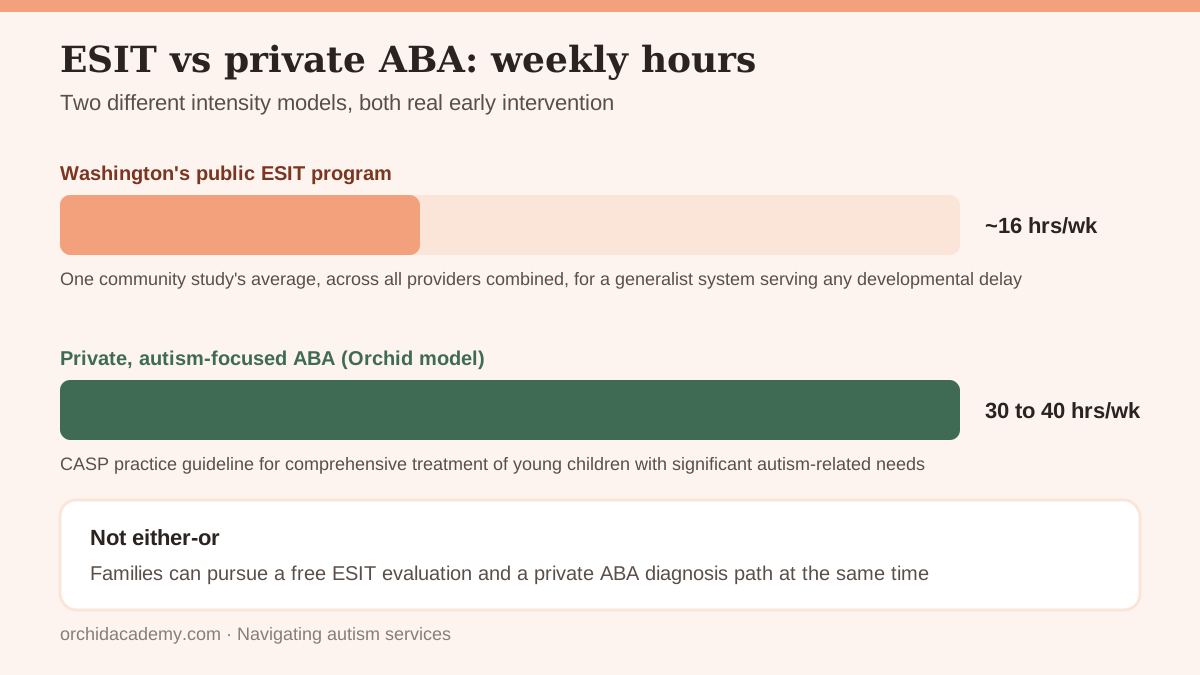
Three real differences follow from that intensity gap:
Methodology. Private ABA-based programs are built entirely around a child’s autism profile: communication, social skills, and behavior targets chosen and adjusted by a BCBA, rather than serving a broader mix of developmental needs the way a generalist public system does.
Access. A private program isn’t tied to the state’s Part C intake and staffing pipeline, so it isn’t subject to the same public-system capacity constraints. It is, however, gated a different way: insurance coverage for ABA typically requires a formal autism diagnosis, which ESIT does not require. If your child hasn’t been diagnosed yet, why a diagnosis is needed for ABA and where to get one on the Eastside are worth reading before you call around.
The window itself. The CDC notes that when developmental concerns are identified early and children get needed services, outcomes improve. Roughly 1 in 31 8-year-olds nationally has autism, so this isn’t a rare situation to plan for. ESIT or not, more hours of targeted, autism-specific intervention during ages 2–3 tend to matter for how much ground a child covers before kindergarten.
Can a family use both?
Often, yes, and it’s worth checking rather than assuming you have to pick. Families frequently pursue an ESIT evaluation right away, since it’s free and doesn’t require a diagnosis, while separately getting on a waitlist for a formal autism evaluation, which opens the door to insurance-funded private ABA. The two systems aren’t formally coordinated with each other, so nothing about enrolling in one automatically enrolls you in the other, but there’s no rule against a child receiving ESIT-coordinated services (like speech or OT) while also starting private ABA once a diagnosis and insurance authorization are in place. If autism is suspected but not yet confirmed, a simple screener can help you decide whether it’s worth pursuing that second track now instead of waiting.
Starting this week
Two calls are worth making in the same week, not sequentially. First, call the Help Me Grow Washington hotline at 1-800-322-2588 (or contact ESIT directly through DCYF) to start a free evaluation. There’s no downside to getting on the list even if you’re unsure your child qualifies. Second, if autism is a real possibility, start the evaluation process for a diagnosis in parallel; our guide to autism testing and evaluation on the Eastside covers where to go and what the wait looks like right now. Running both tracks at once keeps you from losing months to a process that didn’t need to be sequential.
It also helps to walk into that first ESIT call already knowing what you want to ask: how long until the evaluation happens, what a typical IFSP looks like for a child with your child’s specific concerns, and whether the local provider agency has capacity or a wait. None of those questions require you to already have answers. Family Resource Coordinators field them constantly, and asking early is what shortens the whole process.
If your child has an autism diagnosis (or is close to one) and you want to understand what 30–40 hours of ABA-based early intervention looks like week to week, talk to our team or read more about early intervention at Orchid.
Frequently asked questions
Is early intervention free in Washington?
The core of it is. Under Part C of IDEA, Washington's ESIT program provides outreach, evaluation, assessment, the IFSP, and service coordination at no cost to families. Some direct therapy services may be billed to insurance, but only with your written consent, and the system is built so no family is turned away because they cannot pay. Private ABA-based early intervention is usually billed to health insurance instead.
How do I start early intervention?
Call the Help Me Grow Washington hotline at 1-800-322-2588 and ask to be connected with a Family Resources Coordinator, or contact ESIT directly through DCYF. You do not need a doctor's referral, and parents can self-refer. A team then evaluates your child, and if your child qualifies, you build an Individualized Family Service Plan together. If autism is likely, start a diagnostic evaluation at the same time.
What age is best for early intervention?
As early as you have a concern. ESIT serves children from birth until their third birthday, and the CDC notes that outcomes improve when developmental concerns are identified early and children get needed services. You do not need to wait for a formal diagnosis to request an ESIT evaluation. For autism-specific ABA, more hours of targeted intervention during ages 2 to 3 tend to matter for how much ground a child covers before kindergarten.
Is early intervention an IEP?
No. Early intervention for children under 3 uses an Individualized Family Service Plan, or IFSP, under Part C of IDEA. An IEP comes from your school district under Part B. ESIT services end at the third birthday, and the transition plan made in the months before connects your child to a district evaluation. If your child is eligible, the district writes an IEP, which should be in place by the third birthday.
Does my child need an autism diagnosis for early intervention?
Not for ESIT. A child qualifies through a documented delay in one of five developmental areas, a qualified professional's informed opinion, or a diagnosed condition known to cause delay, and autism is one of the listed conditions. Private ABA-based early intervention is different, because insurance coverage for ABA typically requires a formal autism diagnosis before services are authorized.
See how our team can support your child
Keep exploring
- ABA therapy at Orchid Academy
Evidence-based autism therapy across our academies, homes, and schools.
- New autism diagnosis guide
First steps after a diagnosis: therapies, hours, siblings, and finances.
- Find an Orchid location
Issaquah, East Wenatchee, Bothell, Kirkland, Sammamish, Bellevue, Covington, Federal Way, and telehealth.
Related Articles
ABA Reauthorization: What Insurance Reviews and Why Hours Get Cut
ABA reauthorization decides whether therapy continues and at how many hours. What your plan reviews, why hours get cut, and what to do before the next review.
Oct 30, 2026 · 9 min read
Autistic Child Kicked Out of Daycare in Washington? What to Do This Week
If your autistic child was kicked out of daycare in Washington: what the rules require, your rights under the ADA, free evaluations, and full-day options.
Oct 30, 2026 · 7 min read
ABA Therapist Turnover: What's Normal and What Your Provider Owes You
ABA therapist turnover is common. What the research says, what a provider should do when your child's RBT leaves, and what to ask about staffing at intake.
Oct 23, 2026 · 9 min read