
Autism Signs in Children: A Parent's Guide to Next Steps

If you are noticing differences in your child’s communication, play, sensory needs, routines, or friendships, you do not need to decide on a diagnosis by yourself. A parent can notice useful patterns; a qualified clinician makes a diagnosis. This guide helps you turn concern into a clear next conversation with your child’s doctor or care team.
It is not a diagnostic screener. The CDC distinguishes developmental monitoring, screening, and diagnostic evaluation: a screening tool can flag a need for a closer look, but it does not provide a diagnosis. See CDC’s parent overview.
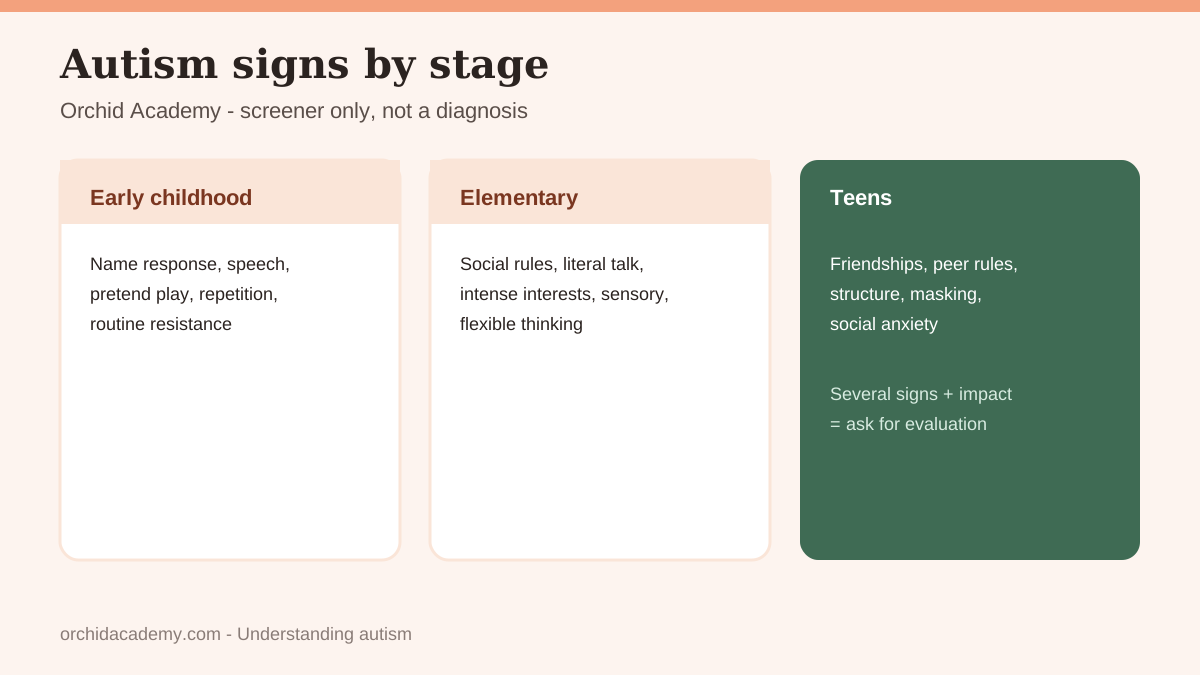
Notice patterns, not a score
One trait does not equal autism. Children can be quiet, intense, literal, shy, sensory-seeking, or routine-loving for many reasons. What is useful to share with a professional is a pattern that affects everyday life: communication, play, learning, self-care, family routines, friendships, or recovery after a busy day.
Write down what you see, where it happens, how often it happens, and what helps. A short set of examples is more useful than trying to decide whether a website checklist adds up to a label.
Possible patterns in toddlers and preschoolers
Every child develops on an individual timeline. These are examples to discuss with a pediatrician or developmental professional, especially when they occur together or affect daily life:
- Communication that is delayed, unusual for the child, or has changed over time
- Limited shared play, pretending, or back-and-forth interaction
- A strong preference for predictable routines or distress with unexpected change
- Repetitive movements, play patterns, or intense interest in parts of objects
- Sensory reactions that make everyday sounds, clothing, foods, lights, or movement difficult
The CDC’s family resources include developmental-milestone materials that can help you describe a concern by age without treating a milestone list as a diagnosis. Explore the resources for families.
Possible patterns in elementary-age children
School can make social, language, and sensory differences more visible because children are managing group rules all day. A family might notice:
- Difficulty joining flexible play, reading a group situation, or recovering from a social mix-up
- Very literal interpretation of language, jokes, or implied directions
- Intense interests that bring joy but are hard to shift away from when the setting changes
- Sensory needs that make classrooms, lunchrooms, assemblies, or transitions exhausting
- A large gap between how the child seems at school and how depleted they are at home
These experiences can overlap with many other developmental, learning, mental-health, and environmental factors. An evaluation is meant to look at the whole picture.
Possible patterns in teens
Some young people recognize differences later, when friendships, independence, and the number of unspoken social rules increase. Topics worth raising with a professional can include:
- Ongoing difficulty forming or maintaining relationships despite wanting connection
- Feeling uncertain about hidden expectations, sarcasm, or group dynamics
- Needing substantial recovery after school, social events, or sensory-heavy environments
- Relying on rigid routines to manage change
- Copying peers to get through the day while feeling confused or exhausted afterward
Girls and young people who are socialized to appear agreeable can be overlooked when adults focus only on visible behavior. That does not mean every quiet or tired teen is autistic. It means their experience deserves a careful, respectful conversation. Our guide to social support for autistic girls at school offers practical ideas after that conversation.
What to do if you are concerned
- Record a few examples. Note the situation, what your child did or communicated, and what helped.
- Talk with the pediatrician or primary-care clinician. Ask whether developmental screening, a specialist referral, school evaluation, or another next step makes sense.
- Ask what the referral is for. Screening, a diagnostic evaluation, speech-language assessment, learning evaluation, and mental-health support answer different questions.
- Use support while you wait. If your child is under three, early-intervention services may be available without waiting for a final autism diagnosis. For Washington-specific options, see early intervention programs near you.
- Tell the school what you are observing. A school can discuss learning and support needs even while a medical evaluation is pending. Our Washington IEP guide explains the school-side process.
If your child loses skills they previously had, is in immediate danger, or you are worried about urgent safety or mental-health needs, contact the appropriate clinician or emergency support promptly.
Where Orchid fits
Orchid Academy does not diagnose autism. If your child receives a diagnosis and you are considering ABA, our new autism diagnosis guide explains the early decisions, and why a diagnosis is needed for ABA explains why diagnostic documentation matters for insurance-funded ABA.
If you want to talk through the service path after a diagnosis or evaluation, request a call back. A provider can help you understand intake and benefits verification; the diagnostic question belongs with a qualified evaluating clinician.
Find out how our expert team can support your child’s journey:
Dr. Autumn Flick, BCBA
Board Certified Behavior Analyst
Keep exploring
- Understanding autism
Early signs by age and how to seek an evaluation.
- If you receive a diagnosis
A calm first-steps guide for Washington families.
- Early intervention ABA
Intensive support for young children building foundational skills.
Related Articles

Autism Strengths: Focus, Memory, Detail, and Real-World Examples
Strengths that often show up with autism (focus, memory, detail, pattern recognition) plus people who have talked publicly about how those traits show up in their work.
Jun 26, 2024 · 3 min read