
Stuck on an Evening ABA Waitlist? Consider Daytime Sessions

Evening ABA slots fill first. That is why those waitlists stretch for months while daytime hours sit open. If your child is not getting what they need from a full school day right now, daytime sessions are worth a hard look.
A note from an Orchid parent
As a parent, I understand the challenge of balancing school with services during school hours. When our son started kindergarten, we paused ABA to focus on school. By December we needed ABA again.
Reallocating school time was hard. Aligning ABA with his IEP goals let teachers focus more on academics and social skills while his BCBA and BTs taught tools that helped him engage at school. After assessment and treatment planning, we requested an IEP meeting with his BCBA present and built a hybrid schedule: some days school mornings and ABA afternoons, other days the reverse. We authorized direct communication between BCBA and teacher. By third grade he was working independently, engaging with peers, and had graduated from ABA.
Is school meeting your child’s needs right now?
Two patterns show up a lot:
Severe behaviors. Aggression, self-injury, or disruption that blocks learning turns school into a stress cycle for the child, the class, and you. Daytime ABA can target those skills intensively so a return to school is more successful.
Passive and checked out. No blowups, but the child sits in the back, skips peer interaction, and floats through the day. That quiet disengagement still costs academic and social progress. Focused daytime support can rebuild participation skills before the gap widens.
Partner with the school
Daytime ABA works best when therapy goals and IEP goals talk to each other. The school can lean into peer practice and academics while ABA builds the underlying skills. Put the BCBA–teacher communication in writing so it actually happens. For IEP structure, see IEP sections explained and our Washington IEP guide.
Look at the real school schedule
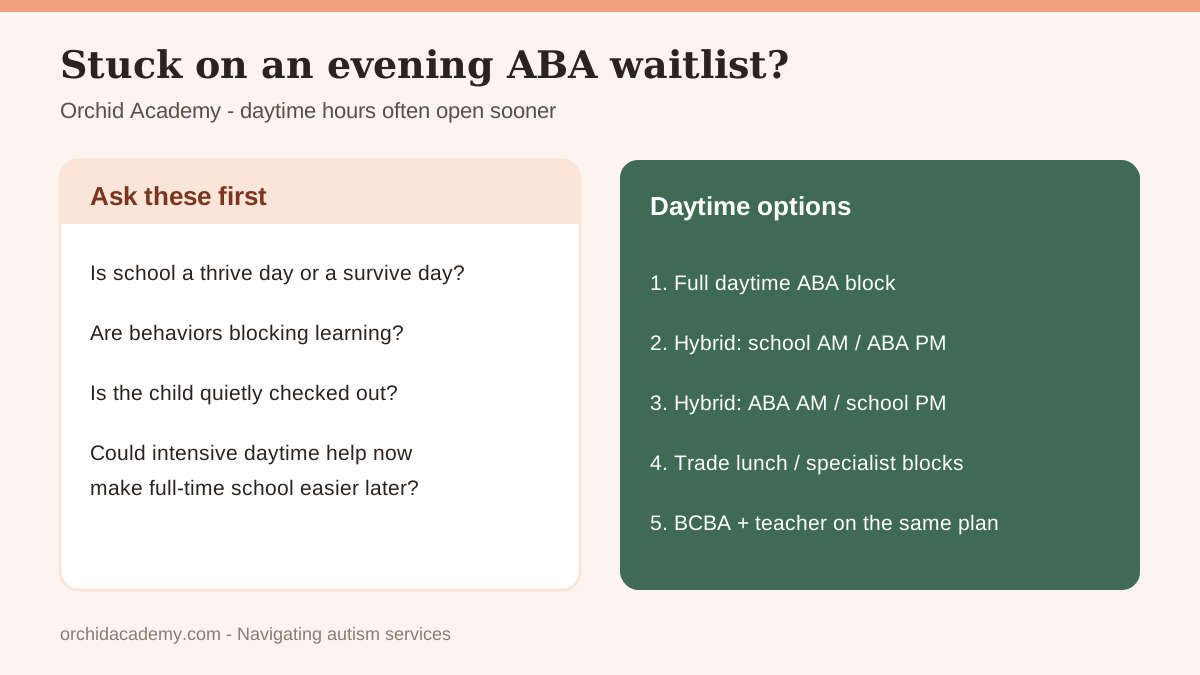
How much of the day is specialists, transitions, lunch, and recess? Those blocks are often the least costly to trade for therapy hours. A hybrid plan does not have to mean “no school.” It can mean mornings at school a few days a week and afternoons in ABA, or the reverse.
Questions to ask yourself on the waitlist
- Is my child thriving in the current school day, or surviving it?
- Are behaviors or disengagement blocking learning and friendships?
- Would intensive daytime support now make full-time school more successful later?
Waiting for an evening slot is frustrating. If school is not meeting your child’s needs right now, ask whether daytime or hybrid hours can start sooner than the evening waitlist. If you want to talk through those options at Orchid, request a call back or read academy vs in-home ABA.
See how our team can support your child
Dr. Autumn Flick, BCBA
Board Certified Behavior Analyst
Keep exploring
- Orchid locations accepting families
Daytime academy seats and in-home options across Washington.
- Ask about current availability
We can help match hours that fit your family.
- ABA therapy at Orchid Academy
Evidence-based autism therapy across our academies, homes, and schools.
Related Articles
ABA Reauthorization: What Insurance Reviews and Why Hours Get Cut
ABA reauthorization decides whether therapy continues and at how many hours. What your plan reviews, why hours get cut, and what to do before the next review.
Oct 30, 2026 · 9 min read
Autistic Child Kicked Out of Daycare in Washington? What to Do This Week
If your autistic child was kicked out of daycare in Washington: what the rules require, your rights under the ADA, free evaluations, and full-day options.
Oct 30, 2026 · 7 min read
ABA Therapist Turnover: What's Normal and What Your Provider Owes You
ABA therapist turnover is common. What the research says, what a provider should do when your child's RBT leaves, and what to ask about staffing at intake.
Oct 23, 2026 · 9 min read