
Behavioral Momentum: How to Ease Into a Hard Request

You need a hard thing done (stand up, put on shoes, leave the toys) and everyone is stuck. Behavioral momentum is a warm-up: a few easy requests your child will already do, delivered quickly with clear praise, then the harder ask while that success streak is still going.
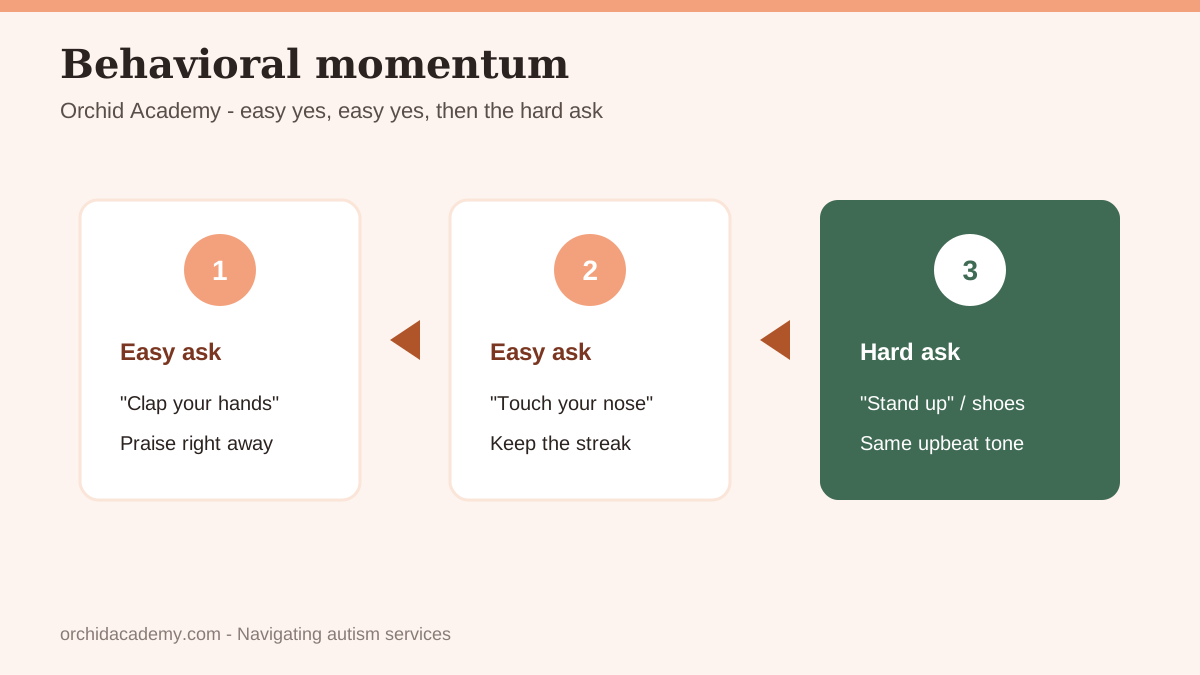
How to run it
- List a few high-probability asks (clap, touch nose, high-five, hand me the block).
- Deliver one easy ask. Praise the response.
- Deliver another easy ask. Praise again.
- When the streak is rolling, give the harder ask in the same upbeat tone.
- Keep the hard ask as small as the moment allows (stand up, then take one step, not “clean the whole aisle and check out”).
Grocery-store example
Child is on the floor. You need to move:
- “Clap your hands!” → clap → “Nice clapping.”
- “Touch your nose!” → touches → “Got it.”
- “Touch your head!” → touches → “Yes.”
- “Stand up!” → stands → “Thanks for standing.”
- Keep moving with short, quick wins toward the cart or door.
Speed and a confident tone matter. Long lectures between steps kill the momentum.
When it helps
- Transitions (“trains down, shoes on”)
- Unexpected asks mid-preferred activity
- Tasks the child usually escapes
If they are deep in trains and you only say “shoes, now,” expect pushback. Route through a couple of easy wins first, or bridge with another preferred micro-task, then the shoes.
This does not mean dropping the requirement. It means lowering the approach difficulty so the requirement is doable. Practice when everyone is calm so the pattern is available on hard days. Ask your BCBA to tailor high-probability asks for your child, or contact Orchid.
What “high-probability” means
A high-probability ask is something your child already does, quickly, most of the time: clap, high-five, touch a body part they know, hand you a block they were going to hand you anyway. If you are not sure they will do it, it is still the hard ask.
Keep the easy asks fast (a second or two apart) and the praise short. A speech after every clap kills the streak. The hard ask should be the next small step. Ask them to stand up, not to clean the aisle, pay, and load the car.
When not to use it
Skip momentum if your child is already in a full meltdown, injured, or so flooded that they cannot hear you. Safety and regulation come first. See meltdown prevention and public meltdowns.
Skip it if the “easy” asks are actually aversive (touching a texture they hate, or a social routine they are avoiding). You will teach them that warm-ups are a trap.
Do not use a long chain of easy asks to sneak in something you have no right to force. Keep the next step small enough to do.
Other places it shows up
- Leaving the park: two easy motor asks, then “hands on the stroller”
- Turning off a tablet: “tap the case,” “hand me the charger,” then “tablet off”
- Homework or therapy: two known items, then the new one
- Group time at school or clinic: easy motor responses, then sitting for one more minute
If you try it three times and the hard ask still never happens, the hard ask is too big, the easy asks are not easy, or leaving the toy is too steep. Shrink the ask. Talk to your BCBA before you add prompts or extra reinforcers that change the program.
Frequently asked questions
Is this the same as “just give them a warning”? No. A warning is information. Momentum is a short run of successful responses so the next response is more likely.
Can I do this with a non-speaking child? Yes. Motor responses (touch, clap, hand me) work. Pair with their communication system for the hard ask when the ask is communicative.
Will my child catch on and refuse the easy asks? Sometimes, if every warm-up predicts something they hate. Mix in easy asks that do not always lead to a demand, and keep the hard ask small enough that winning is common.
By Tessy Thomas
Find out how our expert team can support your child’s journey:
Dr. Autumn Flick, BCBA
Board Certified Behavior Analyst
Keep exploring
- ABA therapy at Orchid Academy
Evidence-based autism therapy across our academies, homes, and schools.
- New autism diagnosis guide
First steps after a diagnosis: therapies, hours, siblings, and finances.
- Find an Orchid location
Issaquah, East Wenatchee, Bothell, Kirkland, Sammamish, Bellevue, Covington, Federal Way, and telehealth.
Related Articles
ABA Therapy for Teens: What Age-Respectful Care Looks Like
ABA therapy for teens should focus on useful goals, real choice, privacy, school, and adult life. Learn what to ask before choosing a provider.
Sep 9, 2026 · 8 min read
How to Switch ABA Providers Without Losing Momentum
How to switch ABA providers: line up care, handle insurance, transfer records, and ask for a written handoff without creating an avoidable gap.
Sep 9, 2026 · 7 min read
ABA Programs in Sammamish, WA: School-Based and In-Home Options
Looking for ABA programs in Sammamish, WA? Compare Orchid Academy's school-based support at Sammamish Children's School with in-home ABA, insurance, and what to ask on the first call.
Aug 28, 2026 · 6 min read