
Does Medicaid Cover ABA Therapy? A Washington Apple Health Guide
Does Medicaid cover ABA therapy? In Washington, yes. Medicaid here is called Apple Health, applied behavior analysis is a covered benefit for eligible children, and for most families it costs nothing out of pocket. Washington does put one specific gate in front of that coverage, though, and most national guides never mention it. Families who don’t know about it lose months waiting in the wrong line.
Does Medicaid cover ABA therapy?
Yes, for children who qualify. Medicaid includes a benefit for everyone under 21 called EPSDT, which requires the state to cover medically necessary services that correct or improve a condition found during screening. That is why a child’s ABA coverage follows clinical need rather than a flat state limit.
In Washington, Medicaid is Apple Health. The Health Care Authority lists ABA as a covered treatment for clients with autism spectrum disorder and other developmental and intellectual disabilities. For most families it carries no copay, coinsurance, or deductible.
Medicaid eligibility for ABA in Washington
Your child needs three things:
- Apple Health coverage, either through a managed care plan or fee-for-service.
- An evaluation from the right provider. Clients 20 and younger must be seen by an Apple Health approved Center of Excellence. Clients 21 and older see a neurologist, psychiatrist, or psychologist.
- A prescription, or order, for ABA from that evaluation.
Who qualifies for Apple Health for Kids? Children up to age 19 get free coverage when household income is at or below the state limit, which is $5,913 a month for a family of four (HCA updates the limits every April). Children under 6 on free coverage stay covered through the month they turn 6, even if income changes. Families earning more can buy low-cost coverage for $20 or $30 a month per child, but only if the child has no other insurance. HCA’s children’s coverage page lists the limit for every household size.
ADHD by itself does not meet that bar under HCA’s ABA billing guide. Our post on ABA therapy for ADHD explains why and what to ask for instead. The rest of this guide covers the gate that trips up most families and the steps that follow it.
The Center of Excellence gate
Washington’s Health Care Authority requires two things before Apple Health will authorize ABA:
- Your child must be evaluated by an Apple Health approved Center of Excellence (COE) provider.
- That evaluation must produce a prescription, or order, for ABA therapy.
A COE is a state-approved diagnostic site, not an ABA clinic. This is the step families skip. A parent gets an autism diagnosis from a pediatrician or a private psychologist, calls an ABA provider, and discovers the diagnosis they already have doesn’t unlock Apple Health coverage, because it didn’t come from a COE. That is a genuinely frustrating conversation to have six months in.
The rule splits by age. Clients 20 and younger must be seen by an ABA COE provider. Clients 21 and older see a neurologist, psychiatrist, or psychologist instead.
The four steps, in order
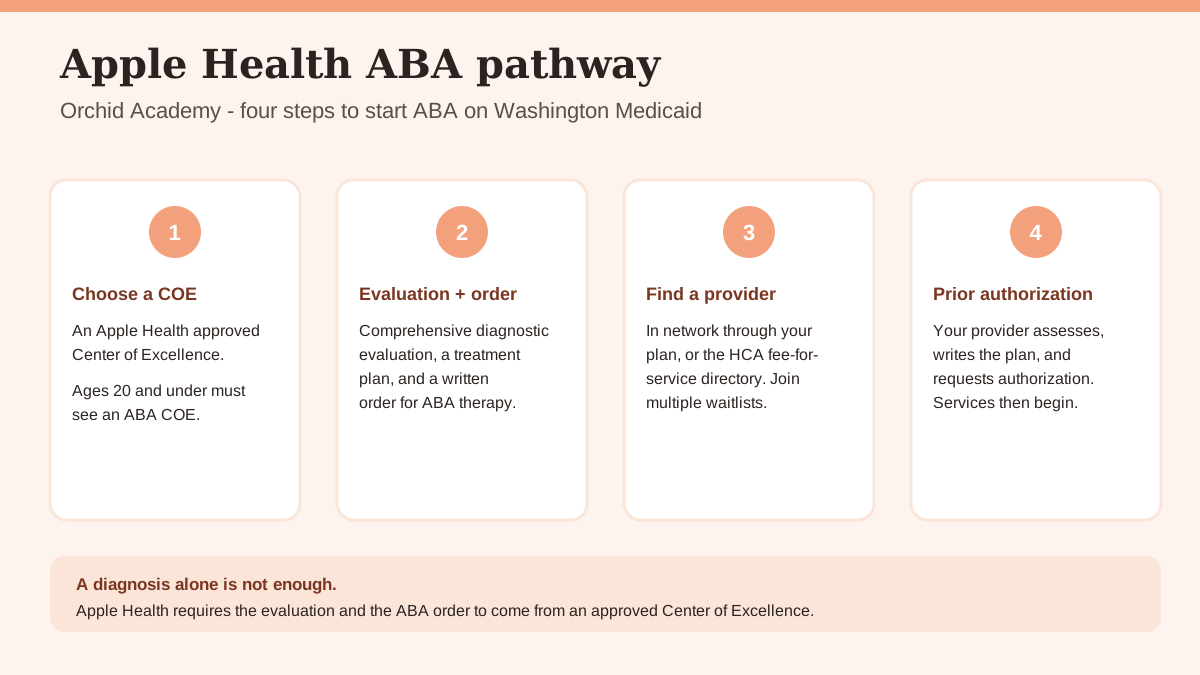
Step 1: Choose a Center of Excellence provider. If your child is in an Apple Health managed care plan (Molina, Coordinated Care, Community Health Plan of Washington, Wellpoint, or UnitedHealthcare Community Plan), call the plan. They can find an in-network COE, connect you with an ABA case manager, and walk you through the benefit. If your child is on fee-for-service Apple Health instead, you pick from HCA’s published Centers of Excellence provider list.
Step 2: Diagnostic evaluation and ABA order. The COE completes a comprehensive diagnostic evaluation, recommends a multidisciplinary treatment plan, and orders ABA if it’s appropriate. You receive a copy of both the evaluation and the order. Keep them. You hand them to your ABA provider, and the ABA provider cannot move without them.
Step 3: Find an ABA provider. Managed care families call their plan for an in-network list. Fee-for-service families use the Apple Health ABA provider directory, which HCA also publishes in Spanish.
Step 4: Intake and prior authorization. Your ABA provider completes intake assessments, writes an individualized treatment plan, and requests prior authorization. Services start once that authorization comes through.
HCA’s own advice about waitlists
HCA says this plainly, which is unusual for a state agency. It is common for providers to have wait lists, and HCA tells families to contact all area ABA providers who accept Apple Health and get on multiple wait lists to reach the first available appointment.
That’s permission, from the payer, to do the thing that feels rude. You are not gaming the system by joining five lists. You are doing what the agency running the benefit recommends. Our guide to why a diagnosis is needed for ABA therapy covers the diagnostic side of the same waiting problem.
Why children’s coverage is broader than adults’
Medicaid carries a protection for anyone under 21 called EPSDT, short for Early and Periodic Screening, Diagnostic, and Treatment. In practice it means that if a service is medically necessary to correct or improve a condition found during a screening, the state has to cover it for a child, even if the adult benefit package is narrower.
For ABA, EPSDT is the reason a child’s medically necessary hours aren’t capped by a flat state limit the way an adult service might be. Coverage follows clinical need. It also means that when you hear about federal changes to ABA policy, the first question worth asking is whether EPSDT is affected. As of October 2026, it isn’t: none of the federal changes HCA has announced for 2027 change EPSDT for children.
What the August 2026 federal guidance changed, and what it didn’t
On August 4, 2026, CMS released the State Medicaid and CHIP ABA Toolkit, a 173-page document aimed at state agencies. If you saw headlines about it, they probably sounded alarming.
CMS reported that ABA spending across Medicaid and CHIP rose 421% between 2021 and 2025, while the number of children with an autism diagnosis receiving services grew 67%. The toolkit is the response, and it gives states guidance on medical necessity, provider credentialing, supervision, payment methodology, and fraud detection.
What it explicitly does not do, in CMS’s own words, is establish new federal requirements, reduce EPSDT obligations, endorse any single treatment approach to ABA, or direct states to limit access to medically necessary care. It is guidance to state agencies, not a rule change that reaches your child’s authorization.
States may act on it over time, though, and some of its suggestions would be felt by families if adopted. It advises states to look hard at telehealth use, at how many hours per week are warranted, and at how much consecutive therapy gets billed without a break for the child. Washington has not changed its ABA rules in response to the toolkit. Separately, the Health Care Authority opened a rulemaking in April 2026 on its ABA rules (preproposal notice). HCA says the goal is to clarify Center of Excellence paperwork, add requirements for ABA assessments and treatment plans, and improve prior authorization and renewals. No draft rule has been published yet. If rules change, it will show up in your authorization, and your provider should be the one telling you.
What the 2027 Apple Health changes mean for your child
Federal law (H.R. 1) changes Apple Health starting January 1, 2027, but most of it targets adults. Work requirements and six-month renewals apply to Apple Health for Adults, ages 19 to 64, not to children’s coverage.
One change does reach kids. Retroactive coverage, the months before your application that Apple Health can pay for, shrinks from three months to two for children’s programs. If your child may qualify, apply as soon as you can rather than waiting until a bill arrives. ABA itself needs prior authorization before it starts, so this mostly affects evaluations and other care your child received before enrolling. HCA’s changes page has the details.
The ABA billing codes also change on January 1, 2027. That is a coding change, not a coverage change. Our post on the 2027 ABA code changes explains what it means for an authorization.
What you should not be paying
For most Apple Health families, ABA carries no copay, no coinsurance, and no deductible. If an ABA provider asks you to pay privately for a service Apple Health covers, or asks you to sign an agreement making you responsible for the balance, stop and call your managed care plan before signing anything. Our post on ABA therapy billing red flags covers what federal auditors have actually been finding, and what a family can check on their own.
Cost questions look very different on commercial insurance, where deductibles and coinsurance are real. If you’re comparing, how much ABA therapy costs breaks that side down.
If you have both Apple Health and commercial insurance
Plenty of families do. Commercial insurance pays first and Apple Health acts as secondary, often covering the copays and coinsurance the primary plan leaves behind. Tell both your ABA provider and your COE that you have both, at intake, in writing. Coordination-of-benefits problems are much easier to prevent than to unwind after six months of claims.
Orchid Academy is in network with Medicaid (Washington Apple Health) and Molina Healthcare, along with Premera Blue Cross, Regence, Blue Cross Blue Shield, Cigna, Aetna, Asuris Northwest Health, Personify Health, and TRICARE. We serve families across Bellevue, Issaquah, Bothell, Sammamish, Covington, Federal Way, and East Wenatchee, with both in-home and center-based ABA.
If you’re not sure which step you’re on, request a call back and we’ll tell you honestly, including when the next step is a COE appointment we can’t schedule for you. You can also explore Apple Health care by city, see the full insurance coverage guide, or browse all Orchid locations.
Frequently asked questions
Why don't all ABA providers accept Medicaid?
Each practice decides which payers it works with, and Medicaid comes with its own requirements. In Washington, a provider has to be enrolled with Apple Health, must be in a managed care plan's network to see that plan's members, and needs prior authorization before ABA services start. HCA also says wait lists are common, which is why it tells families to join several.
How much does 40 hours of ABA therapy cost with Medicaid?
For most Apple Health families, ABA costs nothing out of pocket, with no copay, coinsurance, or deductible, regardless of the number of hours. The hours themselves have to be medically necessary and approved through prior authorization. On commercial insurance, the family's share depends on the plan's deductible and coinsurance, so the same schedule can cost very different amounts.
Can I get ABA through Apple Health if my child was diagnosed by a pediatrician?
Not with that diagnosis alone, unless the pediatrician is an approved Center of Excellence provider. Apple Health clients 20 and younger need an evaluation and an ABA order from a COE before a provider can request authorization. Managed care families can ask their plan to find an in-network COE. Fee-for-service families choose from HCA's published COE list.
Does Medicaid limit how many hours of ABA a child can get?
Not with a flat state cap for children. Under EPSDT, Medicaid has to cover medically necessary services for anyone under 21, so a child's hours follow clinical need. Each schedule still goes through prior authorization. The 2026 CMS toolkit suggests states review weekly hours, but it does not reduce EPSDT obligations, and Washington has not changed its ABA rules in response. HCA has opened a separate rulemaking on ABA paperwork and prior authorization, with no proposed rule published yet.
Will the 2027 Medicaid work requirements affect my child's ABA?
No. Washington's Health Care Authority says the work requirements and six-month renewals starting January 1, 2027 apply to Apple Health for Adults, ages 19 to 64, not to children's coverage. The change that does reach children is shorter retroactive coverage: two months instead of three for children's programs, starting in 2027.
What is the income limit for Apple Health for Kids in Washington?
For free coverage, it is $5,913 a month for a household of four, with different limits for other household sizes. HCA updates the numbers every April. Families above that limit may buy low-cost coverage for $20 or $30 a month per child, but only for children who have no other health insurance.
Does Medicaid cover ABA therapy for adults in Washington?
Apple Health's ABA benefit is not limited to children. Clients 21 and older follow a different first step: instead of a Center of Excellence, they see a neurologist, psychiatrist, or psychologist for the evaluation. EPSDT protections apply only to people under 21, so adult coverage can be narrower than a child's. Check the specific requirements with your plan or HCA.
See how our team can support your child
Keep exploring
- Find ABA care that takes Apple Health
Compare Medicaid ABA options in Issaquah, Wenatchee, Bothell, and Bellevue.
- ABA therapy insurance in Washington
Carriers Orchid accepts, authorization timelines, and what to ask your plan.
- Verify your benefits with Orchid
Request a call back and we help families check coverage before care starts.
Related Articles
ABA Reauthorization: What Insurance Reviews and Why Hours Get Cut
ABA reauthorization decides whether therapy continues and at how many hours. What your plan reviews, why hours get cut, and what to do before the next review.
Oct 30, 2026 · 9 min read
Does Aetna Cover ABA Therapy? A Guide for Washington Families
Does Aetna cover ABA therapy? For autism, yes, when its medical necessity guide is met. What Aetna asks for, the hours it uses, and what to ask before you start.
Oct 30, 2026 · 7 min read
How Long Does It Take to Start ABA Therapy? The Washington Timeline, Step by Step
How long does it take to start ABA therapy in Washington? The nine steps from diagnosis to first session, the insurer deadlines, and how to shorten the wait.
Oct 23, 2026 · 9 min read