
Which ABA Codes Washington Pays by Video
Washington does not treat every Zoom ABA hour as the same service. Apple Health will pay for some clinician work by video: caregiver coaching, group caregiver coaching, and BCBA-directed treatment. It will not pay an RBT to run the child’s technician hours through a laptop. Sorting out which of those services you are getting is the real decision at intake.
National clinics often sell one product under one label. The claim on the EOB is still a CPT code. If a provider cannot tell you which code they will bill by video, you do not know what you are buying.
The four things people call Zoom ABA
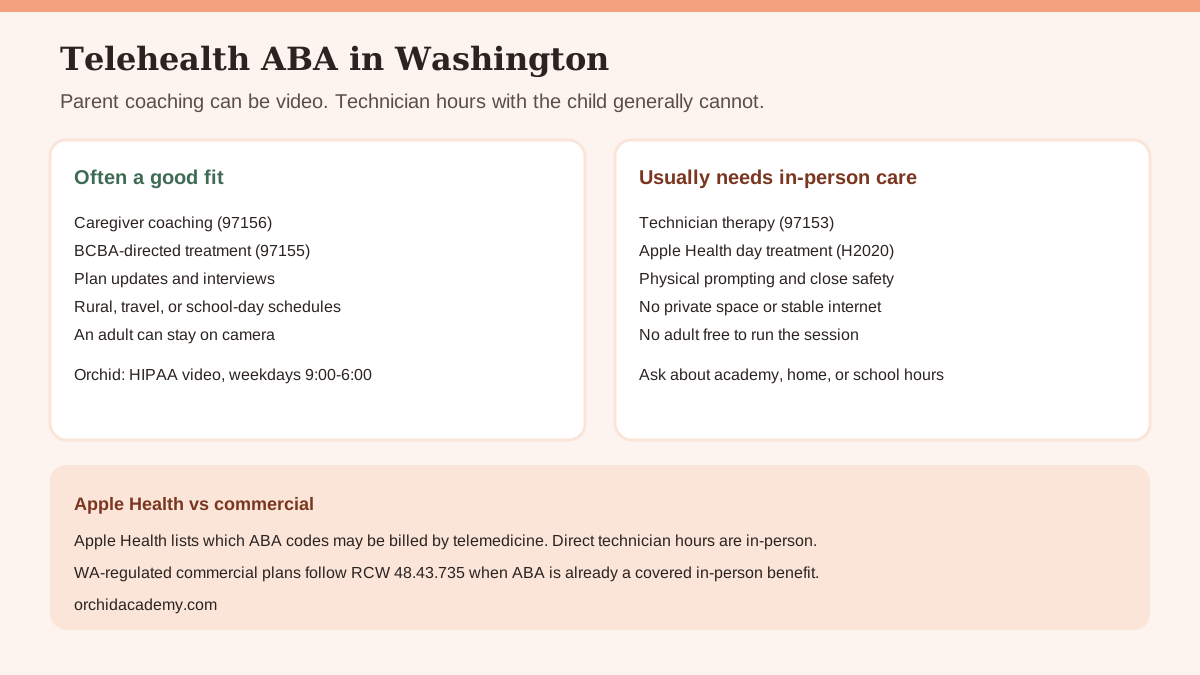
Caregiver coaching (97156). A BCBA meets with you, with or without the child, and trains you on a strategy you will use in real routines. This is the format Orchid uses statewide. What CPT 97156 should look like covers how to tell coaching from a packet.
BCBA-directed treatment (97155). The clinician observes, adjusts the plan, and coaches the adult or technician who is with the child. Apple Health can pay this by telemedicine when quality is not compromised.
One caution for 2027: on January 1, 2027, the CPT code book narrows 97155 to the BCBA directing a technician and moves a BCBA’s own direct treatment to a new code, 97173. Apple Health has not yet published a 2027 billing guide saying whether 97173 can be billed by video, so check again when it does. Our post on the 2027 ABA code changes has the details.
Direct technician therapy (97153). An RBT or behavior technician teaches the child in real time. Many national pages market this as virtual ABA. Washington Apple Health does not pay for 97153 by telemedicine.
Assessment and planning. Caregiver interviews, rating scales, record review, and treatment-plan work can happen by video. Direct observation of the child, and assessments that require the child to demonstrate skills in real time, are a different category. Apple Health limits telemedicine assessment to indirect activities.
Ask which of those four you are buying before you sign. The label on the website is not the service on the claim.
Codes Apple Health allows by video
The January 1, 2026 ABA Program Billing Guide is the primary source. Parent training (97156), group parent training (97157), and BCBA-directed treatment (97155) may be billed by video.
For caregiver training, the originating site is where the caregiver is. For therapy, it is where the client is. Audio-visual is the format HCA describes for extra caregiver sessions after two in-person trainings in day treatment.
Apple Health still requires the usual ABA pathway: a Center of Excellence evaluation and order for clients 20 and younger, then assessment and prior authorization. A video session does not skip that gate. Our Apple Health ABA guide walks the four steps.
Codes that have to be in person
Technician direct therapy (97153), group technician therapy (97154), and intensive day-treatment per diem (H2020) must be in person in a clinic setting under Apple Health rules.
That is why a plan authorized as 20 or 30 technician hours a week cannot quietly convert to Zoom without a new clinical rationale. The hours and the codes are not interchangeable.
Be cautious when the goal requires physical prompting, close safety support, or a teaching environment the caregiver cannot run from a kitchen table:
- a toddler who leaves the camera, dumps the tablet, or cannot attend without an adult managing every second of the session
- self-injury, aggression, or elopement that a remote clinician cannot help contain
- toilet training that needs a bathroom, not a living-room demonstration
- early learners who still need a structured peer setting, materials, and a team under one roof
- families with no private space, no reliable internet, or no adult free to participate
A BCBA who is doing this honestly will say when they need to see the child in person. Washington’s Health Care Authority puts the same duty on clinicians: lead behavior analysis therapists who use telemedicine are responsible for deciding whether the format compromises quality or the outcome of the treatment plan.
If in-person care is the better fit, compare academy and in-home ABA and look at Orchid locations. Video should not be the default because it is easier to staff.
What commercial plans actually require
Coverage depends on the payer, the code, and whether the service is safe to deliver by video. No plan is required to cover ABA simply because a website offers Zoom.
Washington-regulated commercial plans. RCW 48.43.735 says plans issued or renewed after January 1, 2017 must reimburse a telehealth service when the plan already covers that service in person, the service is medically necessary, it is an essential health benefit, and it can be provided safely and effectively. The statute is not a standalone ABA mandate. If the plan covers ABA in person and the video session meets those tests, reimbursement should follow. Employer self-funded (ERISA) plans follow federal rules, not this statute, so ask the plan administrator directly.
Every commercial plan still has its own prior authorization. Network status, place-of-service codes, and whether 97156 is even on the authorization letter all matter. A benefits check beats a blog. Start with ABA insurance coverage in Washington.
Video tends to help when the main need is coaching the adult, the important routines already happen at home, a caregiver can stay on camera, or the family is rural, traveling, or stretching a schedule around school. Orchid’s program is built for that list: HIPAA-compliant video, weekdays 9:00 to 6:00, with a BCBA. Kim Chu supervises home programs. See telehealth ABA in Washington for hours, software, and how to start.
What a billed video session requires from the family
Video only works if someone on your end can run the session. Before you accept a video-only offer, check:
- a private room, or at least a predictable corner, for 30 to 60 minutes
- a laptop or tablet on a stand, not a phone you have to hold
- internet stable enough that the BCBA can see faces and hear the child
- an adult who can follow a direction without also cooking, driving, or supervising three other children
- a backup plan if the child leaves, the Wi-Fi drops, or a sibling walks in
- toys, visuals, and snacks the clinician asked you to have ready
- a way to practice the same strategy after the call, not only during it
If that list is impossible most days, say so. A clinic that still pushes a full video schedule is staffing its calendar, not yours.
Questions to ask before you accept video hours
- Which service am I getting: caregiver coaching, BCBA-directed treatment, or technician hours with my child?
- Which CPT codes will you bill, and has the plan authorized them for telemedicine?
- Who is on camera besides my child, and what do you need me to do?
- How do you decide that video is still clinically appropriate?
- What happens if my child cannot stay in view or becomes unsafe?
- How often will we meet in person, if at all?
- Is the platform HIPAA-compliant, and where is the recording policy written?
- If Apple Health is the payer, are you billing a code HCA actually allows by telemedicine?
- If this is meant to cover a wait for in-home or academy care, what is the plan when a seat opens?
- How will you coordinate with school, speech, or occupational therapy?
If you are also comparing in-person providers, use questions to ask a new ABA provider. A video setting does not excuse a vague clinical answer.
Video ABA at Orchid Academy
Orchid offers caregiver coaching and BCBA consults by video anywhere in Washington. It is the statewide option for families outside the academy and in-home footprint, and for families who already have in-person care and need coaching that fits a workday. It is not a claim that every child should receive technician-level hours through a screen.
If video is the right tool for the codes your plan will actually pay, request a call back or read telehealth ABA in Washington. If you need academy, home, or school-based hours instead, start with locations. The first conversation should sort out the code and the setting.
See how our team can support your child
Keep exploring
- Telehealth ABA in Washington
HIPAA-compliant parent coaching and BCBA support statewide.
- Parent and family training
The in-person and virtual coaching model those video sessions support.
- ABA therapy at Orchid Academy
Evidence-based autism therapy across our academies, homes, and schools.
Related Articles
ABA Reauthorization: What Insurance Reviews and Why Hours Get Cut
ABA reauthorization decides whether therapy continues and at how many hours. What your plan reviews, why hours get cut, and what to do before the next review.
Oct 30, 2026 · 9 min read
Autistic Child Kicked Out of Daycare in Washington? What to Do This Week
If your autistic child was kicked out of daycare in Washington: what the rules require, your rights under the ADA, free evaluations, and full-day options.
Oct 30, 2026 · 7 min read
ABA Therapist Turnover: What's Normal and What Your Provider Owes You
ABA therapist turnover is common. What the research says, what a provider should do when your child's RBT leaves, and what to ask about staffing at intake.
Oct 23, 2026 · 9 min read