
How Deductibles and HSAs Work for ABA Therapy

Many plans reset deductibles on January 1. ABA is frequent care, so that reset shows up as real bills early in the year. Knowing how deductibles and Health Savings Accounts (HSAs) work keeps services from pausing while paperwork catches up.
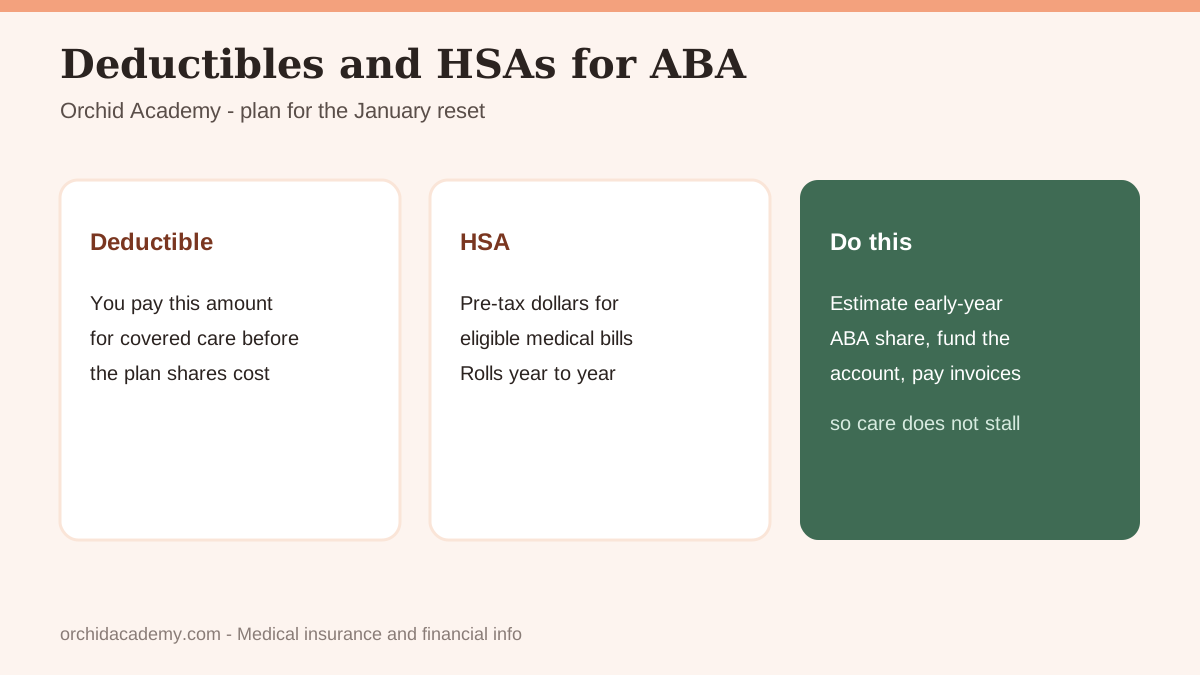
Deductible, in one line
A deductible is what you pay for covered care before the plan starts sharing cost (then co-pays or coinsurance usually still apply until you hit the out-of-pocket max). See insurance terms explained.
For ABA clinics, unpaid deductibles delay payment for work already delivered. That is not abstract: cash-flow gaps make it harder to keep staffing steady. Paying the deductible promptly (via HSA when you have one) keeps the partnership cleaner for everyone.
What an HSA is for
An HSA holds pre-tax dollars for eligible medical expenses, including therapy that counts toward your deductible on a qualifying high-deductible plan. Money rolls year to year. You open one through an employer or a bank/custodian that offers HSAs, then contribute on a schedule so January is not a surprise.
Not every plan is HSA-eligible. If you have an FSA instead, rules differ (use-it-or-lose-it windows, for example). Check which account you actually have.
Practical moves
- Ask your plan for the annual deductible and whether ABA applies to it.
- Estimate early-year ABA cost (authorized hours × your share) and set HSA/FSA contributions to match.
- Pay deductible invoices when they arrive so auth and scheduling do not stall.
- Keep EOBs; they show what applied to deductible vs co-pay.
Local help
Washington Autism Alliance offers family navigation and insurance-related resources (membership is free). For stacking state benefits and grants, see financial help in Washington.
Questions on a specific Orchid invoice or benefits check: contact us or email hope@orchidacademy.com. Full carrier roadmap: Washington ABA insurance guide.
Why ABA makes January feel more expensive than a checkup
A deductible is easier to ignore when you see a doctor twice a year. ABA is frequent care. If you are authorized for 20 hours a week, you can meet an individual deductible in a matter of weeks, not months.
Using the private-pay range from how much ABA costs in Washington ($120 to $150 an hour before insurance), 20 hours is roughly $2,400 to $3,000 a week of billed care. In-network allowed amounts are lower than that, but the shape is the same: early-year sessions apply to the deductible until it is met, then copay or coinsurance until you hit the out-of-pocket maximum. After the OOP max, the plan pays 100% of allowed amounts for the rest of that plan year.
That is why families with “good insurance” still get a real bill in January and February, then a much smaller one by spring. The deductible reset. The plan did not change.
Deductible, coinsurance, copay, OOP max
- Deductible: you pay this amount of allowed charges first.
- Copay: a flat dollar amount per visit or per day, after the deductible (on some plans, copays run alongside it; read your SBC).
- Coinsurance: a percentage of the allowed amount (for example 20%) after the deductible, until you hit the max.
- Out-of-pocket maximum: the cap on what you pay for covered care in the plan year. Premiums do not count. Out-of-network care may have a separate, higher cap, or none.
Family plans often have an individual deductible and a family deductible. ABA for one child can satisfy the individual number while the family number still sits there for everyone else. Ask the plan which one applies to your child’s claims.
Definitions in more detail: insurance terms explained.
HSA vs FSA vs “we just pay the invoice”
For 2026, the IRS set HSA contribution limits at $4,400 for self-only coverage and $8,750 for family coverage, plus a $1,000 catch-up if you are 55 or older (IRS Revenue Procedure 2025-19). Those totals include employer contributions. You can only contribute if you are in a qualifying high-deductible health plan.
HSA money rolls year to year and can pay ABA that counts as a qualified medical expense. That makes it the right tool for a January deductible you can see coming.
An FSA is different. Contribution limits and run-out rules are set by the employer plan. Many FSAs are use-it-or-lose-it, sometimes with a short grace period or a small rollover. Do not assume leftover FSA dollars will be there on January 2.
If you have neither, you still need a cash plan for the first 4 to 8 weeks of the plan year. Spreading nothing and hoping the clinic will wait is how services stall.
A simple planning calendar
- October to November: open enrollment. Confirm the deductible, OOP max, whether ABA is in-network at your clinic, and whether the plan is HSA-eligible. See comparing insurance for ABA.
- December: raise HSA/FSA contributions if you undershot this year’s deductible. Pay any open invoices so you do not carry them into a new year.
- January: expect the bill. Pay it. Keep EOBs. If a claim denies because the new card was not on file, see keeping insurance info updated.
- Spring: check whether you have hit the deductible. If invoices still look like January, call billing and the plan with the EOB in front of you.
Frequently asked questions
Does every ABA hour apply to my deductible? Covered, in-network ABA generally does, until the deductible is met. Denied claims, non-covered services, and some out-of-network balances may not. Use the EOB as the record.
Can I use HSA funds for ABA copays after the deductible? Yes, if the expense is a qualified medical expense and you have HSA dollars. Keep receipts.
What if we cannot pay the January deductible in one shot? Call the clinic and the plan the same week. Some clinics can set a short payment schedule. Ignoring the invoice is what interrupts authorization and staffing. Washington Autism Alliance can help you think through insurance and benefits navigation.
Is Apple Health the same as a deductible plan? Apple Health cost-sharing for most covered pediatric services is minimal to none. The usual constraint is access (waitlists, clinic capacity). Details are in the cost breakdown.
Find out how our expert team can support your child’s journey:
Dr. Autumn Flick, BCBA
Board Certified Behavior Analyst
Keep exploring
- ABA insurance coverage guide
Carriers, costs, and how to plan for therapy.
- Verify your benefits with Orchid
Request a call back and we help families check coverage before care starts.
- ABA therapy at Orchid Academy
How sessions work, what children learn, and where we provide care.
Related Articles
ABA Therapy Billing Red Flags: What Federal Oversight Means for Your Family
ABA therapy billing red flags are in the news after new CMS guidance and four federal audits. Here's what auditors actually found, and what a parent can check without an accountant.
Aug 17, 2026 · 6 min read
Does Medicaid Cover ABA Therapy? A Washington Apple Health Guide
Does Medicaid cover ABA therapy in Washington? Yes, through Apple Health, but only after a Center of Excellence evaluation. Here are the four steps, in order.
Aug 17, 2026 · 5 min read
How Much Does ABA Therapy Cost in Washington State
Real hourly rates, weekly and annual totals, and the actual math behind private-pay, in-network, and Apple Health (Medicaid) ABA therapy costs for Washington families.
Aug 14, 2026 · 7 min read